Animatronics Safety Standards Explained: What Every Builder Needs to Know
There is no single worldwide “animatronics safety standard” that answers every design question. A moving figure may combine machinery, electrical equipment, pneumatic or hydraulic energy, structural supports, scenic materials, software, public interaction, and workplace maintenance. The rules that apply depend on location, venue, use, audience access, energy, and the authority responsible for approval. Builders therefore need a structured safety process, not a favorite checklist copied from another project. That process begins with defined use and foreseeable misuse, continues through hazard identification and risk reduction, and ends with documented verification in the finished installation. Standards such as ISO 12100 provide a machinery risk-assessment method, while other standards address safety-related controls, emergency stops, electrical equipment, guarding, and specific technologies. Regulations and local codes may add enforceable duties. The builder’s job is to identify the applicable framework with qualified professionals and prove that the completed system behaves safely in normal operation, faults, service, and foreseeable human contact.
A: None universally; application depends on jurisdiction, machine design, installation, and use.
A: It is only one protective measure and does not replace risk reduction, guarding, or energy isolation.
A: Only when the required function and architecture are appropriately designed, verified, and validated.
A: Applicable workplace rules and the actual hazardous energy determine the required control process.
A: No. They can still create fire, stored-energy, motion, and high-current hazards.
A: It must prevent relevant access under foreseeable conditions and remain compatible with evacuation and operations.
A: The answer varies; owners, engineers, inspectors, venue safety teams, and authorities may each have defined roles.
A: During concept development, before geometry and energy choices make hazards difficult to remove.
A: No. Inspection, maintenance, controlled changes, and periodic functional tests preserve the validated condition.
A: Stop and resolve the conflict with the responsible authority and qualified professionals before proceeding.
Start With Intended Use and Foreseeable Misuse
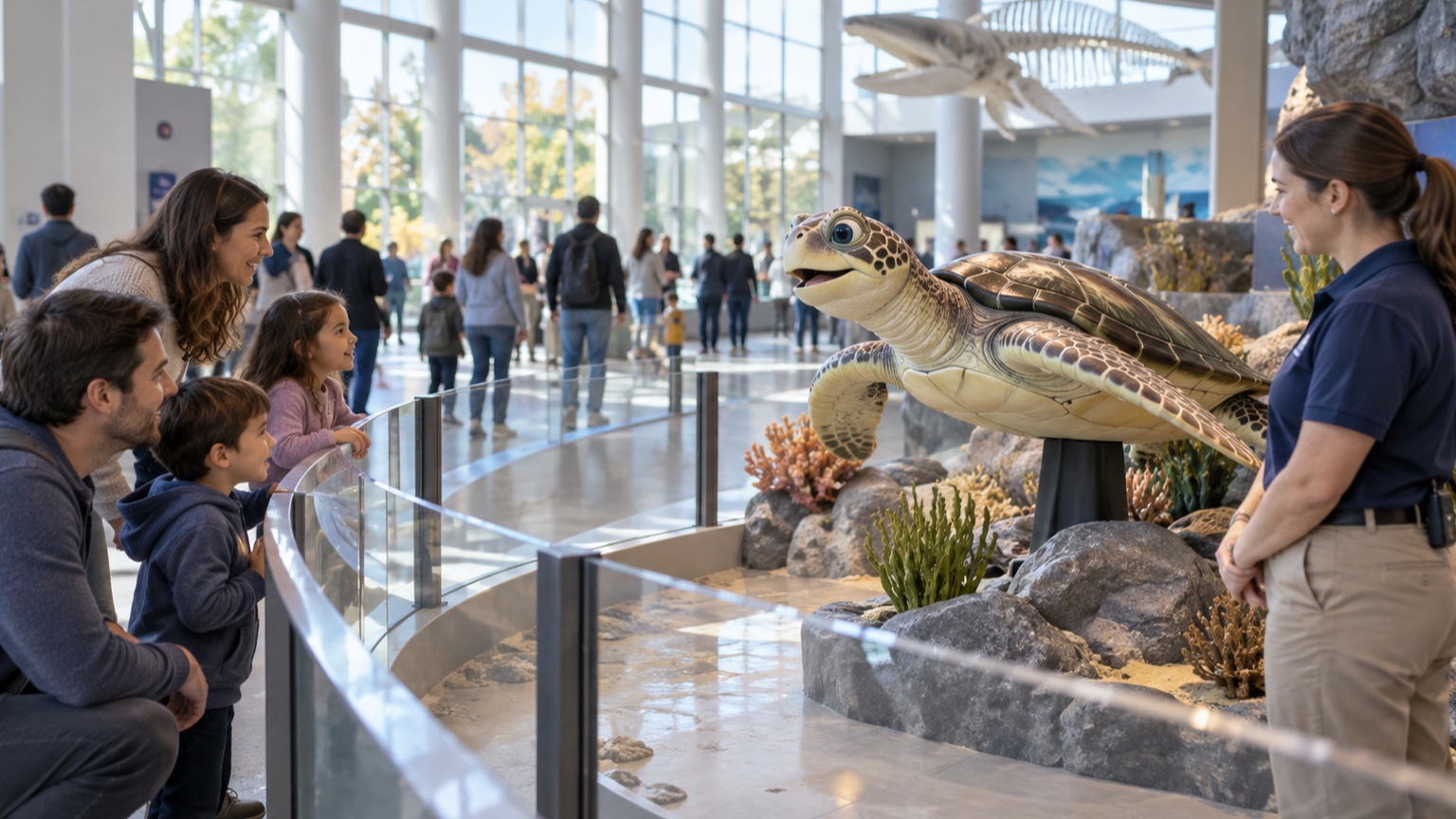
A safety assessment cannot begin with parts alone. Define who will encounter the figure, how close they can approach, who operates it, what maintenance is expected, and what environments it will face. A backstage film creature controlled by a nearby specialist presents different exposure from a museum animal that runs automatically beside children. Document operating modes, transport, installation, cleaning, troubleshooting, decommissioning, and foreseeable misuse such as climbing, reaching through a barrier, or restarting after a fault.
Limits clarify the analysis. State payload, speed, travel, supply pressure, voltage, temperature, wind or weather exposure, and permitted modifications. When a design changes, compare it with those limits. A heavier costume or closer guest route can invalidate conclusions even if the controller and frame remain unchanged.
Use a Risk-Reduction Hierarchy
Effective safety does not begin with warning labels. First remove hazards through inherently safer design where practical: reduce mass, eliminate a pinch point, slow an unnecessary movement, limit force, or locate the mechanism away from people. Next add engineering safeguards such as fixed guards, distance, interlocks, monitored limits, and containment. Information, procedures, training, and warnings address residual risk but depend more heavily on human behavior.
Risk assessment should identify the hazard, exposed people, possible harm, and circumstances of exposure. The team estimates risk, applies measures, and reevaluates until the remaining risk is acceptable under the governing process. The record should explain decisions, assumptions, and verification rather than merely assign colors in a matrix.
Risk reduction must cover the lifecycle. A guarded joint may be safe during shows but exposed when a technician removes the skin. A spring-balanced neck may be controlled while powered yet move unexpectedly during disassembly. Installation crews and cleaners deserve the same deliberate analysis as guests.
Address Mechanical Hazards at the Geometry
Animatronics create crushing, shearing, impact, drawing-in, entanglement, and ejection hazards. Locate them through the full motion envelope and every operating mode. Consider changing clearances as linkages pass, not only the home and end poses. Inspect spaces behind flexible skins because soft coverings do not necessarily remove the force beneath them.
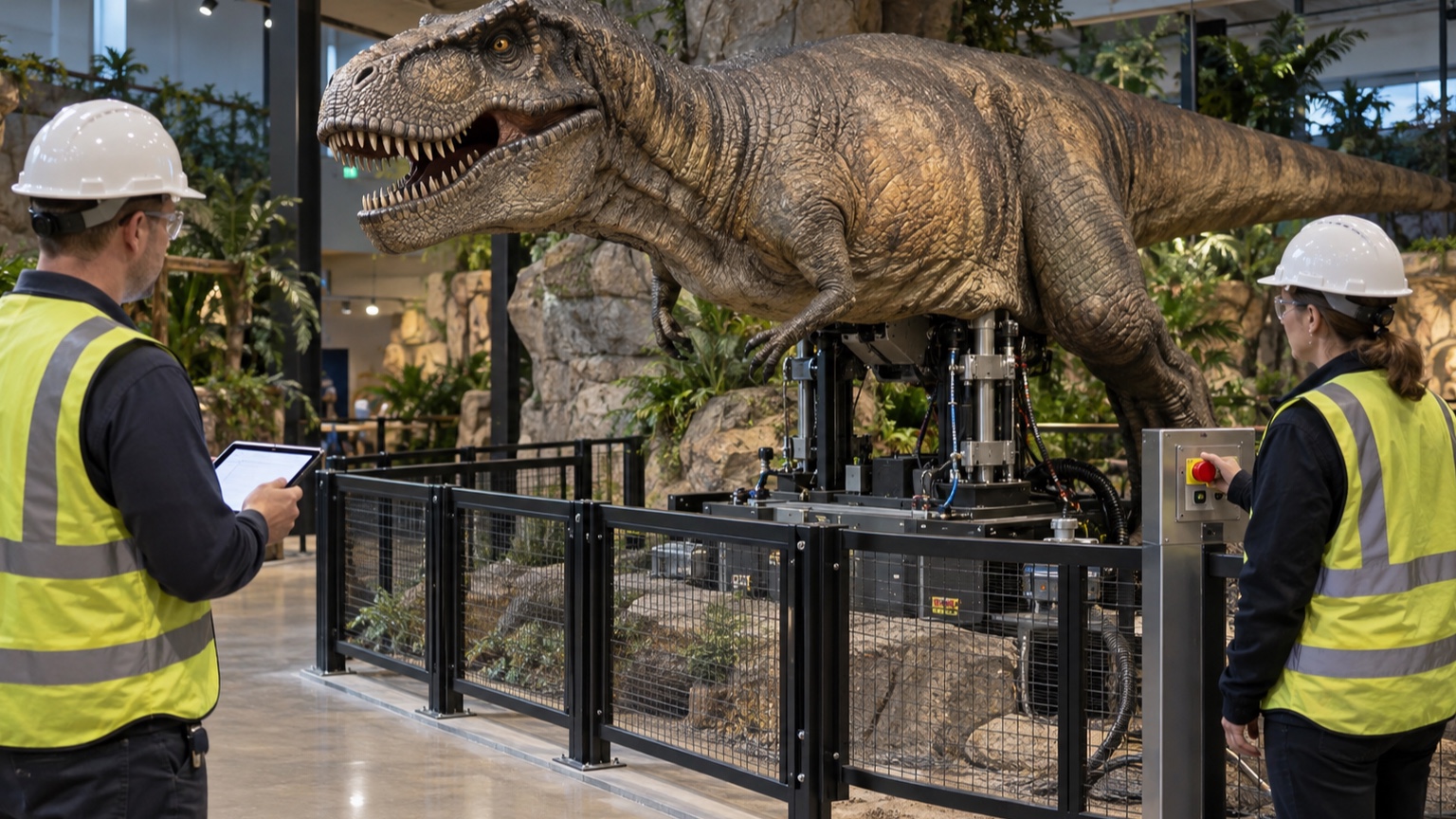
Distance and barriers can be powerful controls when designed for the actual audience. Openings, reach, footholds, mobility devices, and children’s body dimensions affect access. Barriers must also tolerate crowd loads and remain in position. If people intentionally interact with the figure, energy, speed, surface shape, sensing, and fault response require a purpose-built approach rather than assumptions borrowed from a fenced display.
Design Safety-Related Controls Deliberately
Ordinary show control asks the figure to perform. A safety-related control function detects or responds to conditions necessary for risk reduction. Examples may include stopping motion when a protected area is entered, preventing restart while a guard is open, limiting travel, or controlling a safe state after a fault. The required performance depends on the risk assessment, not on convenience.
Standards such as ISO 13849-1 provide methods for safety-related parts of control systems across electrical, pneumatic, hydraulic, and mechanical technologies. Applying such a method involves architecture, component reliability, diagnostics, common-cause concerns, software, and validation. Installing two sensors does not automatically create meaningful redundancy if both share the same vulnerable bracket, cable route, or logic path.
Reset and restart behavior need special attention. Clearing a fault or resetting an emergency stop should not unexpectedly launch motion. Operators need visibility or other controls appropriate to the hazard zone. Bypasses used for setup must be restricted, indicated, and paired with suitable reduced-risk conditions.
Treat Emergency Stops as a Complement
An emergency stop allows a person to intervene in an emergency; it does not prevent every event and does not replace guarding or automatic protective functions. Its placement, actuator design, stop behavior, reset, and circuit architecture must fit the applicable requirements and risk assessment. Staff must be able to reach it without entering the danger they are trying to stop.
Stopping can itself create hazards. Removing power from a vertical axis may permit a fall, while abruptly stopping a large scenic element may overload structure. The design should define a safe stopping response for each energy system. Controlled deceleration may be needed before energy removal, with independent measures to maintain safety if control is lost.
Control Electrical and Fire Risks
Electrical design includes disconnecting means, overcurrent and fault protection, grounding or bonding, conductor sizing, enclosure suitability, wiring methods, heat, and documentation. Standards such as NFPA 79 or IEC 60204-1 may inform machinery electrical work where applicable, while local electrical and fire codes govern installation. A qualified professional should determine the correct framework.
Animatronics pack motors, drives, power supplies, lighting, audio equipment, wiring, foam, fabric, adhesives, and skins into confined spaces. Evaluate heat under representative operation with the finished coverings installed. Protect cables from motion, abrasion, moisture, and sharp structure. Select materials with the venue’s fire strategy in mind and avoid assuming that a low-voltage circuit cannot ignite surrounding material.
Temporary show wiring and touring equipment still require disciplined design. Repeated setup increases connector wear and routing variation. Provide durable distribution, strain relief, inspection criteria, and clear isolation. Any repair that changes conductor type, protective devices, ventilation, or enclosure integrity should be reviewed against the approved design.
Isolate Every Form of Hazardous Energy
Pressing stop is not the same as isolating energy. Electrical supplies, compressed air, hydraulic pressure, elevated loads, springs, counterweights, capacitors, and hot surfaces can remain hazardous after normal shutdown. Maintenance procedures should identify each source, the energy-isolating devices, stored-energy controls, verification method, and conditions for re-energized testing.
In United States workplaces, OSHA’s control-of-hazardous-energy requirements may apply to service and maintenance activities. Other jurisdictions have their own rules. Builders support safe servicing by providing lockable isolation, bleed points, blocking provisions, accessible disconnects, and documentation. Owners must develop and administer the workplace program appropriate to their operation.
Verify Structure, Supports, and Containment
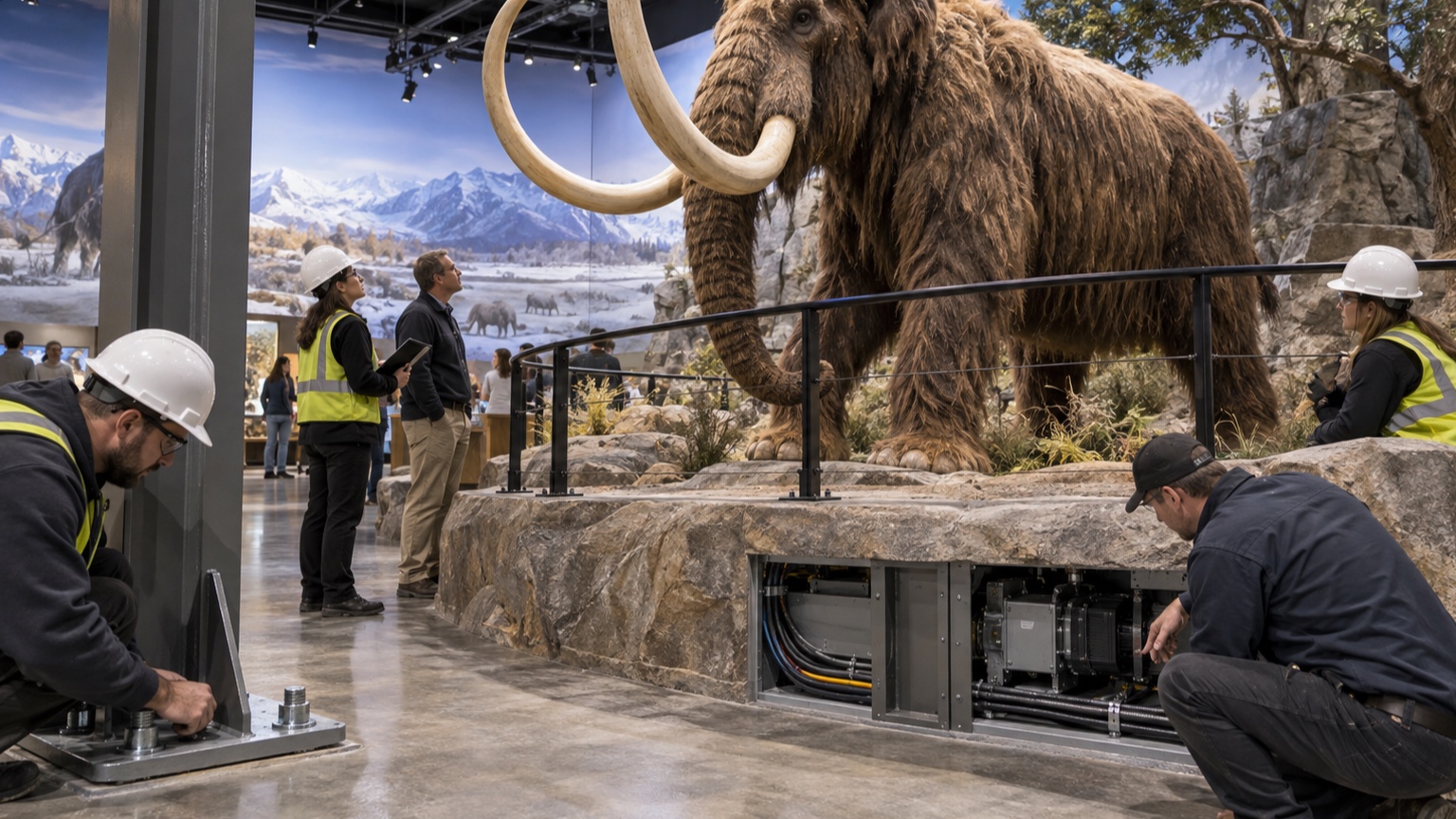
Motion loads differ from static weight. Acceleration, abrupt stops, imbalance, guest forces, wind, transport, and fault conditions transfer forces into frames, anchors, platforms, and buildings. Qualified structural analysis should cover the real load cases and connection details. Base plates and anchors require an adequate supporting substrate; a strong frame attached to weak scenery is not a safe system.
Containment matters when a part could loosen or fracture. Use appropriate fastener retention, guards, secondary retention, or enclosures based on the consequence. Inspect witness marks and torque-controlled connections. Cosmetic panels should not be relied upon as structural guards unless they were designed and verified for that role.
Installation completes the load path. Record anchor locations, specified hardware, tightening or inspection method, and any field deviation. Reverify after relocation, floor changes, structural repair, or significant motion modification.
Account for Public Behavior and Operational Reality
Public installations operate in a social environment that drawings cannot fully represent. Guests lean on rails, lift children for a better view, drop objects, reach through openings, and gather where the designer expected a clear path. Staff may move portable barriers, silence alarms, or repeat a reset while trying to keep a venue open. Observe comparable spaces and include operations personnel in the review so the design addresses behavior that is foreseeable even when it is prohibited.
Crowd management, accessibility, and emergency movement affect safeguarding. A barrier that controls reach must not create an unacceptable trip, entrapment, or evacuation condition. Viewing positions should account for mobility devices and children without encouraging climbing. Lighting and sound must allow staff to recognize a fault and communicate an instruction. If a figure invites touch, define the intended contact areas and prevent access from migrating toward joints, hot surfaces, wiring, or unstable scenery. Operational procedures need clear authority. Staff should know which symptoms require an immediate stop, who may reset a fault, and when technical help is mandatory. A reset limit can discourage repeated cycling of an unresolved condition. Daily opening checks should confirm that barriers, covers, emergency devices, and clearances remain as approved. Incident and near-miss reports belong in the change process, because real behavior can expose assumptions that testing missed.
Validate the Finished Installation
Design review and component certificates do not prove that the assembled figure works safely. Validation checks the implemented measures against their specifications. Test guards, interlocks, limits, stop functions, reset behavior, fault responses, isolation, warnings, access, and documentation. Use controlled conditions, reduced energy where appropriate, and test plans that do not expose people to the hazard being evaluated.
Fault testing should be selected from the safety design and applicable method. It may include disconnected sensors, loss of supply, communication failure, or disagreement between channels, but testing must be planned by qualified people. Record the configuration, instruments, acceptance criteria, results, and corrective actions. Retest after corrections.
The public venue introduces final realities: sight lines, ambient noise, staff positions, queues, lighting, cleaning routes, emergency procedures, and neighboring equipment. Review the figure in this context. A stop button hidden by scenery or a barrier moved for crowd flow can defeat a sound shop design.
Preserve Safety Through Change Control
Safety degrades when modifications bypass the assumptions behind the original assessment. Software timing, speed, skins, props, barriers, replacement actuators, pressures, and venue layouts can all change risk. Establish who may approve changes, what analysis is required, and which tests must be repeated. Preserve versioned backups and accurate drawings.
Inspection and maintenance sustain physical measures. Check guards, anchors, cables, hoses, stops, sensors, emergency devices, and isolation points at intervals linked to use and environment. Define rejection criteria instead of relying on “looks acceptable.” A recurring fault deserves root-cause analysis, especially when it affects a safeguard.
Build a Defensible Safety File
A useful technical file tells the story from intended use to residual risk. It includes requirements, risk assessment, drawings, schematics, calculations, component information, software configuration, test plans, validation results, operating instructions, maintenance and inspection criteria, training needs, and change history. Keep it available to the people who operate and service the figure. Standards are tools inside that process, not decorative references. Confirm current editions and applicability with the authority and qualified professionals; do not claim compliance because a component carries a mark or a checklist was completed. The defensible result is a finished animatronic whose hazards were systematically reduced, whose protective functions were verified, and whose owners know how to preserve that condition.