Creature Design Basics: How to Create Memorable Creatures
The creatures people remember are rarely the ones with the most spikes, eyes, or surface noise. They have a strong overall idea, a recognizable body relationship, and behavior that makes their anatomy meaningful. A memorable creature can be beautiful, strange, funny, threatening, or tender, but its choices feel connected. This guide focuses on the design fundamentals that create that connection: audience role, emotional framing, silhouette, body plan, feature grouping, face and gaze, behavior, motion, color, materials, sound, and presentation. Biological reference remains valuable, yet perfect realism is not the goal. The goal is coherent interpretation. Viewers should sense how the creature occupies space, what it notices, how it responds, and which feature carries its identity. By testing recognition and performance early, you can build a creature that survives different poses, camera angles, scales, and production methods.
A: Clarify its largest body masses and characteristic behavior before adding more surface detail.
A: No. Attention and emotion can come through body orientation, sensory structures, posture, timing, and sound.
A: Give its threat behavior a specific purpose, sequence, cost, and recovery instead of relying only on teeth and spikes.
A: No. Limb arrangement becomes memorable when it changes locomotion, resting shape, interaction, and performance.
A: No. Stable forms help audiences read moving features and reduce visual and mechanical noise.
A: Yes. The contrast can be powerful if anatomy and behavior explain how both impressions coexist.
A: Texture follows material, scale, growth, wear, environment, and deformation rather than covering the body uniformly.
A: Rhythm, breath, pitch, and source location can change how mass, distance, and temperament are perceived.
A: Include neutral, locomotion, attention, interaction, threat or defense, recovery, and any story-critical actions.
A: Protect the central body relationship, behavioral identity, and functional logic that make the creature recognizable.
Decide What the Audience Should Feel
Name the first emotion, the second interpretation, and the later discovery. A creature might first appear formidable, then behave cautiously, and finally reveal careful social intelligence. That sequence gives design choices timing. Broad armor and heavy feet support the first read; a retracting posture and delicate sensory movements reveal the second; cooperative tool use or caregiving behavior delivers the third.
Build a One-Sentence Creature Identity
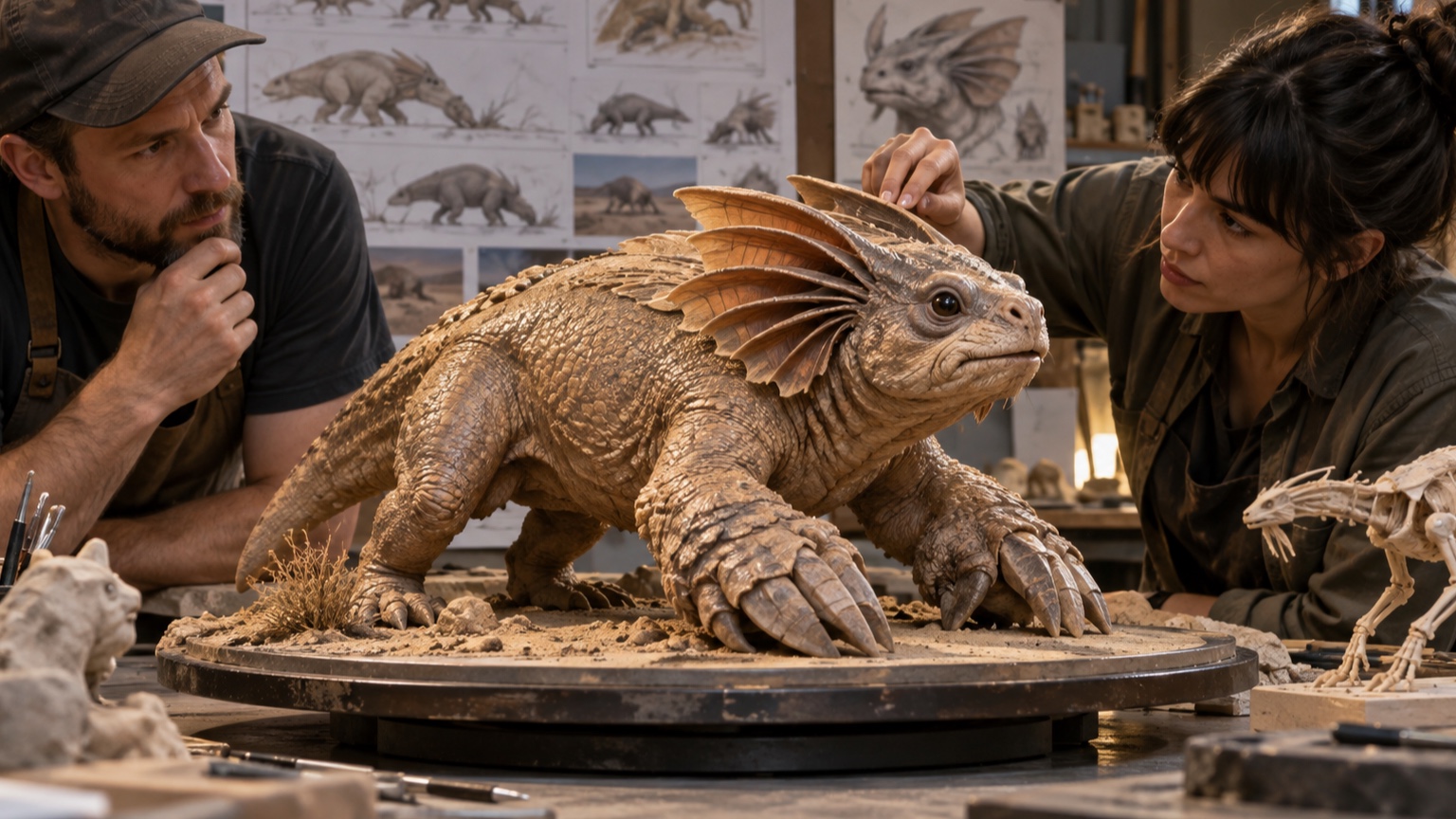
Combine body, behavior, and context. “A compact desert burrower that exposes broad cooling fins only when it feels safe” is more useful than “armored lizard creature.” It suggests mass distribution, digging limbs, heat management, a changing silhouette, and an emotional signal.
List three things the creature does often. Repeated behavior is where audiences form familiarity. Burrowing, listening beneath the sand, and unfolding to cool will become more memorable than a rare dramatic roar if the story spends time with them.
Define one cost or vulnerability. Broad fins can tear, digging overheats the body, or sensitive feet struggle on hard floors. Constraints prevent the creature from seeming like an inventory of advantages and create opportunities for empathy, tension, and distinctive motion.
Create a Readable Body Plan
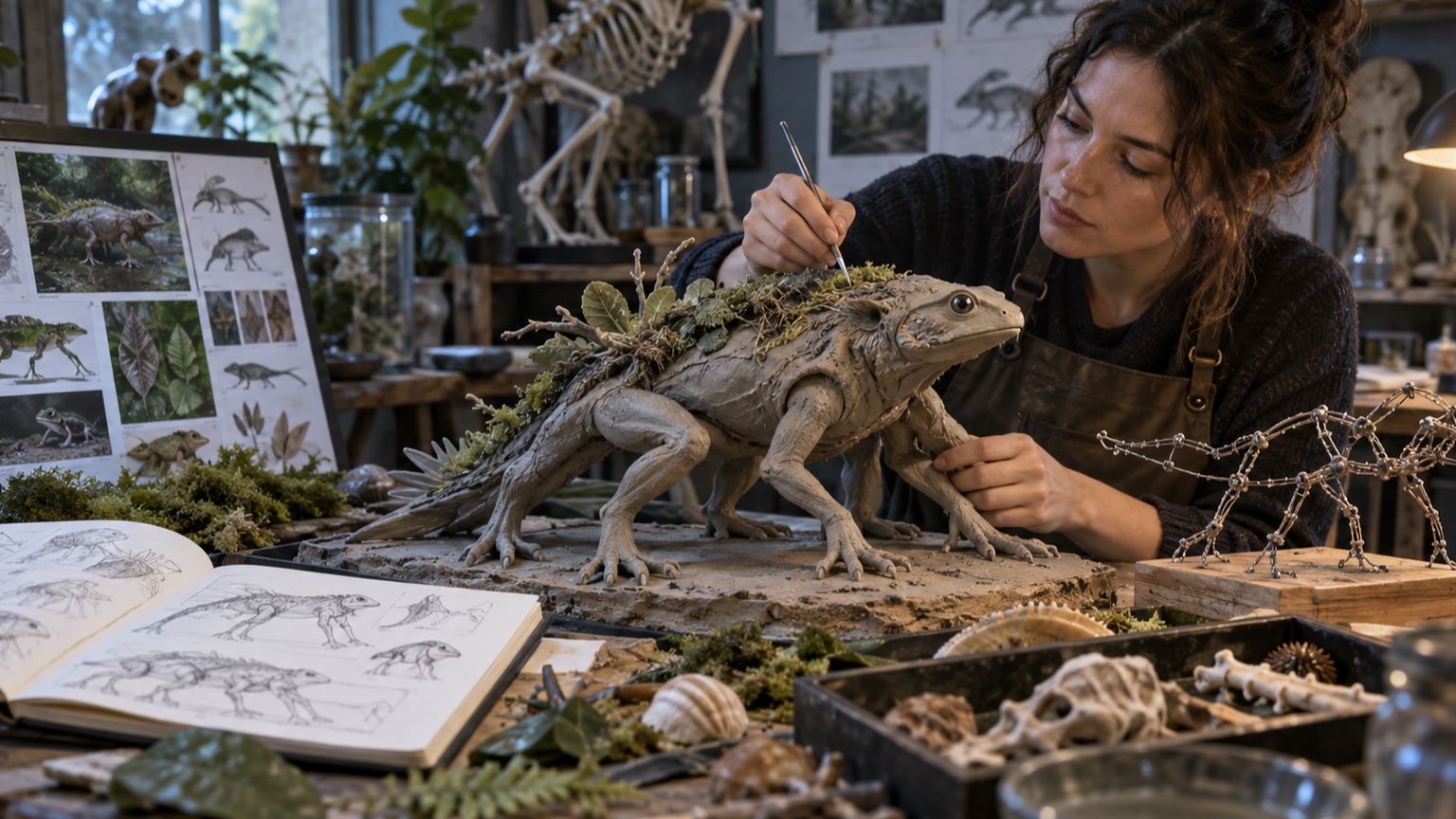
Arrange the spine, major masses, limbs, tail, and sensory regions as simple volumes. Each body region should have a clear relationship to movement and support. Avoid hiding every connection beneath fur, plates, or fog. Viewers do not need anatomical labels, but they need enough structure to anticipate how the creature can move.
Choose where the body carries weight. Front-heavy creatures brace, pull, or dig differently from rear-powered runners. A suspended torso implies different control from a belly that rests on the ground. These decisions shape silhouette and behavior at once.
Find One Dominant Silhouette Relationship
Memorable silhouettes often depend on a relationship: tiny sensory head against enormous digging shoulders, long folded membranes around a compact body, or high delicate legs beneath a heavy protective shell. Explore many variations of that relationship while holding the creature’s role constant. Test neutral and active contours so identity does not rely on a single display pose.
Group Features Into Functional Families
Instead of scattering horns, fins, folds, and plates, group features by purpose and growth. Protective plates may overlap from front to back. Sensory filaments may radiate toward the creature’s attention field. Display membranes may share vein direction and color behavior. Grouping makes complexity understandable.
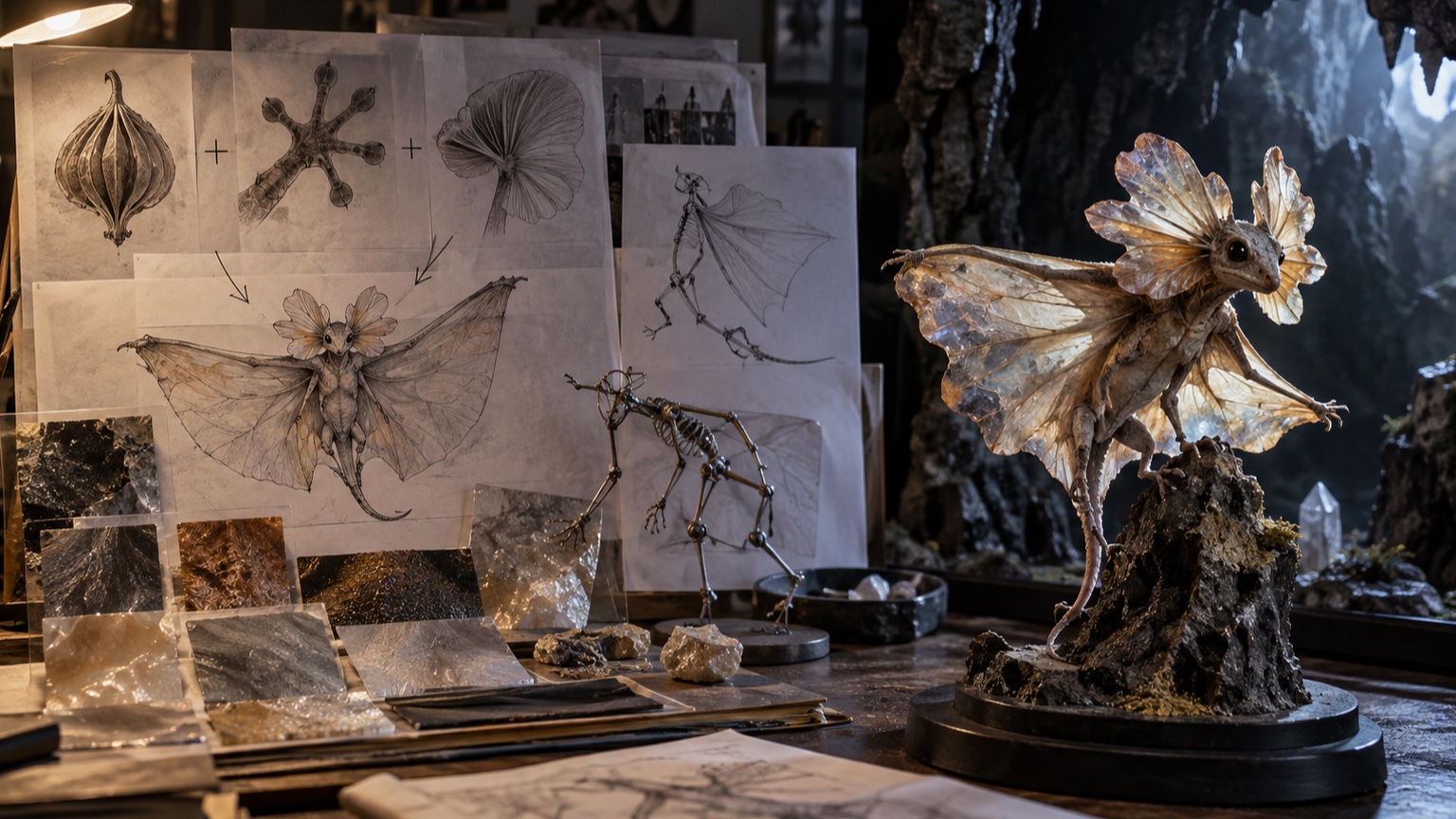
Repeat motifs with variation. A fan shape might appear in ear fins, shoulder transitions, and tail tip, but each instance should fit its local anatomy. Literal copying makes the body feel manufactured. Related curves, tapers, spacing, or branching patterns create unity without cloning parts.
Control transitions. Show how hard shell becomes flexible joint skin, how feathers anchor into a membrane, or how a fleshy sensor retracts into a protected recess. Transitional anatomy often sells the reality of an invented material better than high-frequency texture.
Design Attention Before Facial Expression
Ask how observers know what the creature notices. Eye direction is only one answer. Ears rotate, whiskers project, nostrils lift, shoulders align, feet pause, or the whole body turns. Build an attention sequence from first detection through orientation and decision.
Give the Resting Pose Identity
Rest compresses the design into its most frequently seen arrangement. Decide whether vulnerable parts fold inward, heat surfaces open, limbs tuck, the head remains elevated, or the body contacts the ground. The resting shape should feel comfortable for the anatomy and still preserve the main silhouette relationship.
Use breathing to reveal mass and temperament. Fast shallow motion suggests alertness. A slow expansion across the flanks implies scale and calm. A visible throat pulse may indicate cooling or scenting. For physical creatures, place breathing where a mechanism or performer can create it without distorting rigid landmarks.
Rest also defines readiness. A creature that launches from stillness needs compressed energy and clear foot placement. A social animal may rest while maintaining sensory contact with the group. Design how it wakes, rises, and settles again; transitions make the pose credible.
Avoid an idle loop in which every available feature moves. Constant blinking, ear twitching, breathing, tail sweeping, and head turning flatten the hierarchy and increase wear. Let stillness frame meaningful adjustments.
Create Character Through Reactions
Design a set of responses to the same stimulus: curiosity, uncertainty, trust, irritation, fear, and recovery. Change timing and body organization, not merely the mouth. A curious burrower may lift its fins slightly while keeping feet anchored. Under threat it may flatten the fins, lower the head, and widen contact with the ground.
Small reactions often create stronger attachment than spectacular attacks. Hesitation before accepting food, checking on another creature, misjudging a surface, or relaxing after danger reveals a mind. These beats also give performers and animators repeatable behavioral language.
Shape Locomotion Around Personality
Mechanics establishes what movement is possible; performance establishes how this individual uses it. Two animals with the same anatomy can move differently because of age, status, confidence, injury, or experience. Define stride length, vertical bounce, head stabilization, turning method, and recovery.
Use Color as a Behavioral System
Separate permanent pattern from changeable display. Quiet base colors may support camouflage, while fins, throat, eyes, or flanks reveal brighter color during social states. Decide whether the shift comes from movement, blood flow, iridescence, bioluminescence, or exposed surfaces.
Organize value so anatomy remains clear. Markings should wrap around forms and reinforce direction. High contrast at every edge breaks the creature into pieces. Save the strongest color or value event for the feature that carries attention or communication.
Establish a Material Hierarchy
Choose one dominant surface family, one supporting family, and a limited accent. A mostly matte sand-textured animal may have smoother flexible joint skin and translucent cooling fins. Differences in roughness, thickness, edge, and response to light often communicate more than dozens of texture stamps.
Add wear according to contact. Digging claws polish, leading edges chip, folds collect dust, and protected recesses remain different from exposed surfaces. Consider shedding, regrowth, scars, parasites, grooming, and seasonal change. These systems make detail feel accumulated rather than applied.
For practical fabrication, translate the hierarchy into materials that can move and be repaired. Flexible foam, silicone, fabric, rigid shells, hair, paint, and coatings behave differently under light and repeated motion. Place seams and access points within natural transitions instead of treating them as late compromises.
Add Sound Without Contradicting Scale
Sound has apparent size, distance, material, and effort. A tiny dry click suggests a different body than a resonant chest pulse. Design breathing, contact, locomotion, communication, and exertion as separate layers. Leave acoustic space for quiet behavior; nonstop vocalization can make the creature feel performed rather than alive.
Test What Viewers Actually Remember
Show the creature briefly at realistic scale, then ask viewers to describe its body, behavior, and mood. Use delayed recall and rough redraws. If everyone remembers surface spikes but nobody can explain movement or temperament, decoration is outranking identity. Revise the focal hierarchy, not the viewers.
Present the creature in neutral, locomotion, interaction, display, and recovery. Rotate it to weak angles and remove color. A memorable creature retains its central body relationship and behavioral logic while revealing new information through performance. Protect that core as materials, mechanics, story, and production evolve.
Design the Creature’s Relationship With Others
Memorability grows through interaction. Decide how the creature changes distance, shares space, requests attention, refuses contact, competes, cooperates, and repairs a social mistake. A solitary predator, bonded pair, herd animal, and dependent juvenile interpret the same approach differently. Those reactions turn anatomy into character: a display fin can invite, warn, shield, or imitate depending on timing and orientation.
Build contact rules. Which surfaces can safely touch? Does the animal groom with teeth, hands, antennae, or body rubbing? How does a large creature lower itself toward a smaller partner? Contact reveals scale and temperament, and it exposes whether appendages can reach the actions the story requires. Physical productions should test performer access, pinch zones, flexible surfaces, and repeatable contact forces before choreographing close interaction.
Give social signals a readable sequence. A greeting might begin with distant orientation, continue through a color or posture change, and end with a careful approach. A warning should have escalation and an opportunity to retreat. The audience remembers a creature whose communication can be learned. Repeating a signal consistently allows later scenes to create anticipation by delaying, interrupting, or reversing it.
Use Environment to Reveal Identity
Show how the creature leaves evidence when it is absent. Tracks, displaced soil, polished rubbing surfaces, nests, shed material, food remains, scent-marking behavior, and recurring travel paths connect body design to habitat. The form of a footprint should match the foot and gait; a burrow entrance should match shoulder width and turning strategy. Environmental traces make the creature feel as if it continues living beyond the frame.
Weather and terrain should change performance. Wet plates darken, dust collects in flexible folds, long fur gains weight, and translucent tissue changes against backlight. A memorable creature adapts: it shakes, shelters, selects footing, closes exposed surfaces, or alters travel time. These responses provide quiet behavior and justify material choices without exposition.
Translate the Design Across Production Methods
Identify which qualities create identity and which are medium-specific. An illustration can imply thousands of fibers; a real figure may need grouped clumps that move cleanly and can be replaced. Animation can deform a continuous flank; an animatronic may divide it into rigid landmarks and flexible bridges. Preserve the silhouette relationship, attention sequence, material hierarchy, and behavioral timing while adapting implementation.
For a physical build, map structural support, performer or mechanism space, cable and hose routes, skin stretch, cooling, drainage, transport, and service access. A memorable surface is not successful if routine maintenance destroys it. Place seams at anatomical transitions, align removable panels with plate or fur direction, and design a neutral pose that permits inspection without forcing fragile features.
Create one reference package that translates rather than duplicates. It should show aligned volume, scale, material boundaries, characteristic poses, attention sequence, and movement priorities. Mark which shapes may simplify and which relationships define identity. Review early prototypes beside that package under representative light. When the implementation changes, update the approved reference so the creature does not split into conflicting illustration, animation, and physical versions.