How to Create a Unique Creature Concept
Unique creature concepts rarely arrive as completely unprecedented images. They emerge from unusual questions, selective references, and consequences followed farther than expected. Combining a bat, lizard, and flower may produce a recognizable mashup. Asking how a cave animal could glide between vertical mineral columns, sense air movement without light, and protect fragile membranes while climbing creates a design problem. The anatomy grows from that problem, and originality appears in the relationships among features. This guide presents a repeatable concept-development method. You will map familiar territory, choose a specific niche, build a concept matrix, transform reference functions, impose productive constraints, generate distinct body plans, trace consequences, and test whether the result remains identifiable without superficial decoration. The method does not promise that no similar image has ever existed. It helps you move beyond accidental imitation and generic novelty toward a creature whose habitat, behavior, silhouette, and materials express one coherent point of view.
A: It can begin exploration, but the functions must transform into one connected anatomy rather than remain recognizable parts.
A: Remove color and texture; if a famous source still dominates the silhouette and feature arrangement, transform the underlying relationship.
A: No. Familiar features support readability, and originality can come from their purpose, proportion, behavior, and combination.
A: It blocks an easy solution while creating useful alternatives, such as forbidding vision in a creature that must glide accurately.
A: They prevent minor variations from masquerading as broad exploration and reveal genuinely different solutions.
A: Yes. One unusual functional relationship can support a very clear and economical design.
A: Not always, but related forms can reveal which anatomy is foundational and which features are specialized.
A: Record the source and the exact function, material, behavior, or rhythm you studied so influences remain conscious.
A: Compare the complete concept, revise overly close relationships, and preserve evidence of your independent development process.
A: Stop when one concept best satisfies the niche, emotional goal, originality checks, and production needs with connected consequences.
Map the Familiar Territory First
Research the category, medium, and intended role before falling in love with a silhouette. Gather comparable creatures and sort recurring patterns: wing placement, skull shape, limb count, posture, eye arrangement, surface motifs, color, powers, and behavior. The goal is not to prove every idea exists. It is to see where default solutions cluster.
Mark conventions the audience needs for quick understanding and clichés that do little work. A cave creature may reasonably use sound or touch, but it does not automatically need pale skin, enormous ears, and eyeless facial sockets. Preserve useful cues selectively and seek a different relationship among them.
Write an Unusual Problem Statement
Describe a task under conditions. “Cross vertical crystal columns without touching the toxic floor” is more productive than “make a flying cave monster.” Add resource, threat, and limitation: it feeds on condensation, navigates turbulent air, and must fold delicate sensory membranes while gripping rock.
State the emotional role separately. If the creature should feel elegant rather than frightening, show precision, restraint, and vulnerable concentration. If it should become unsettling only after movement begins, let the resting silhouette conceal the feature that changes perception.
Avoid prescribing the solution inside the problem. “Uses flower wings to glide” ends exploration early. “Controls descent through irregular air while preserving large sensory area” allows membranes, fibers, inflatable forms, distributed fins, or coordinated body surfaces.
Build a Concept Matrix
Create columns for habitat, resource, threat, locomotion, sense, social structure, life stage, material strategy, and audience effect. Fill each with several plausible and surprising options. Combine entries that create tension, such as an adhesive climber with fragile mineral membranes or a social animal that communicates through tiny changes in airflow. Use the matrix to generate questions, not to roll random traits into a creature.
Choose References by Function
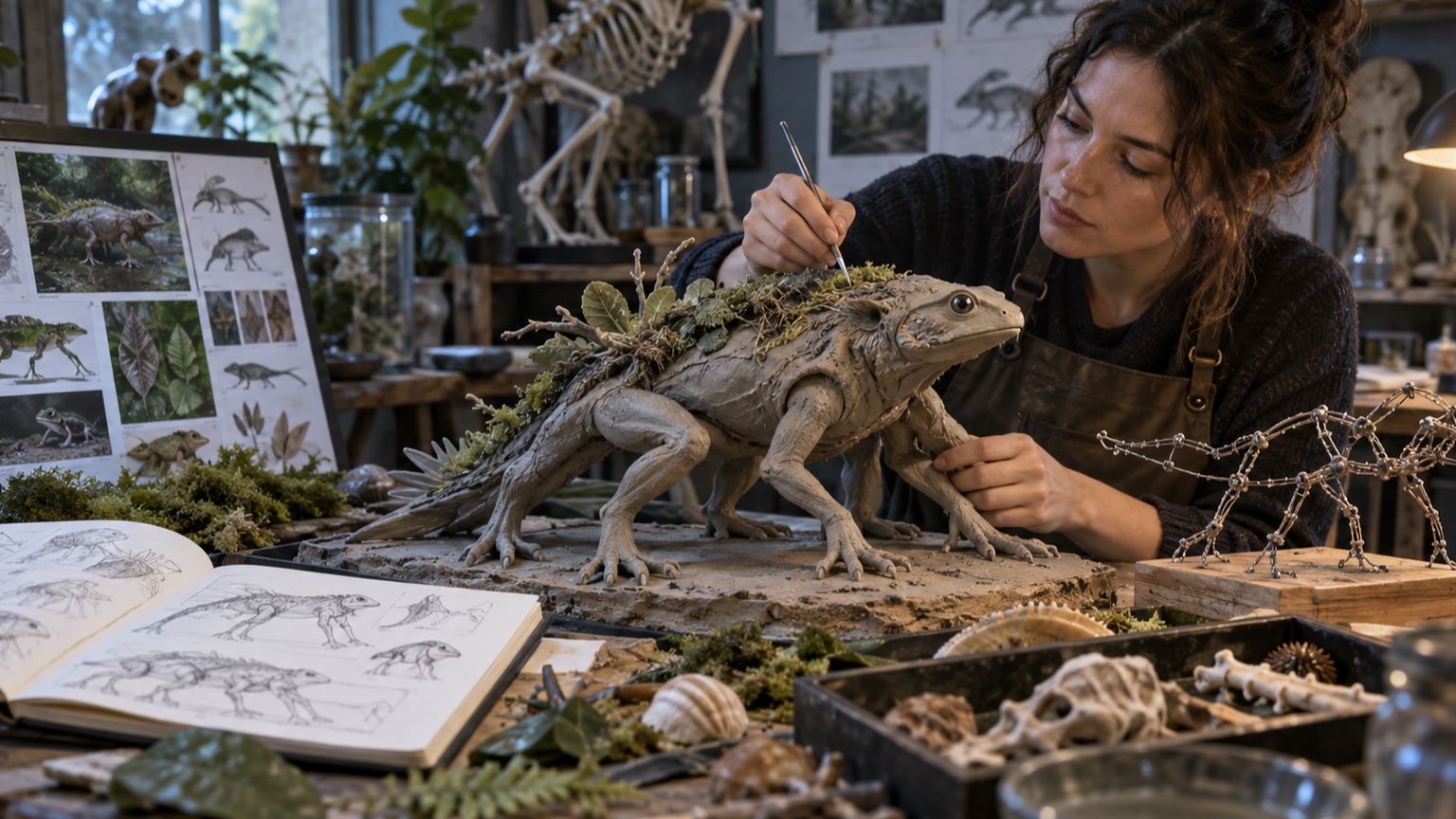
Select different sources for different problems. Study gecko adhesion for repeated attachment, seeds for controlled descent, moth antennae for air sensing, folded leaves for protected deployment, and mineral growth for surface organization. Include machines, architecture, weather, dance, textiles, and plants alongside animals.
Write what you are extracting from each source. “Branching vein rhythm” is safer and more useful than “use this wing.” Functional notes encourage transformation and help collaborators see why a reference matters.
Transform Instead of Assemble
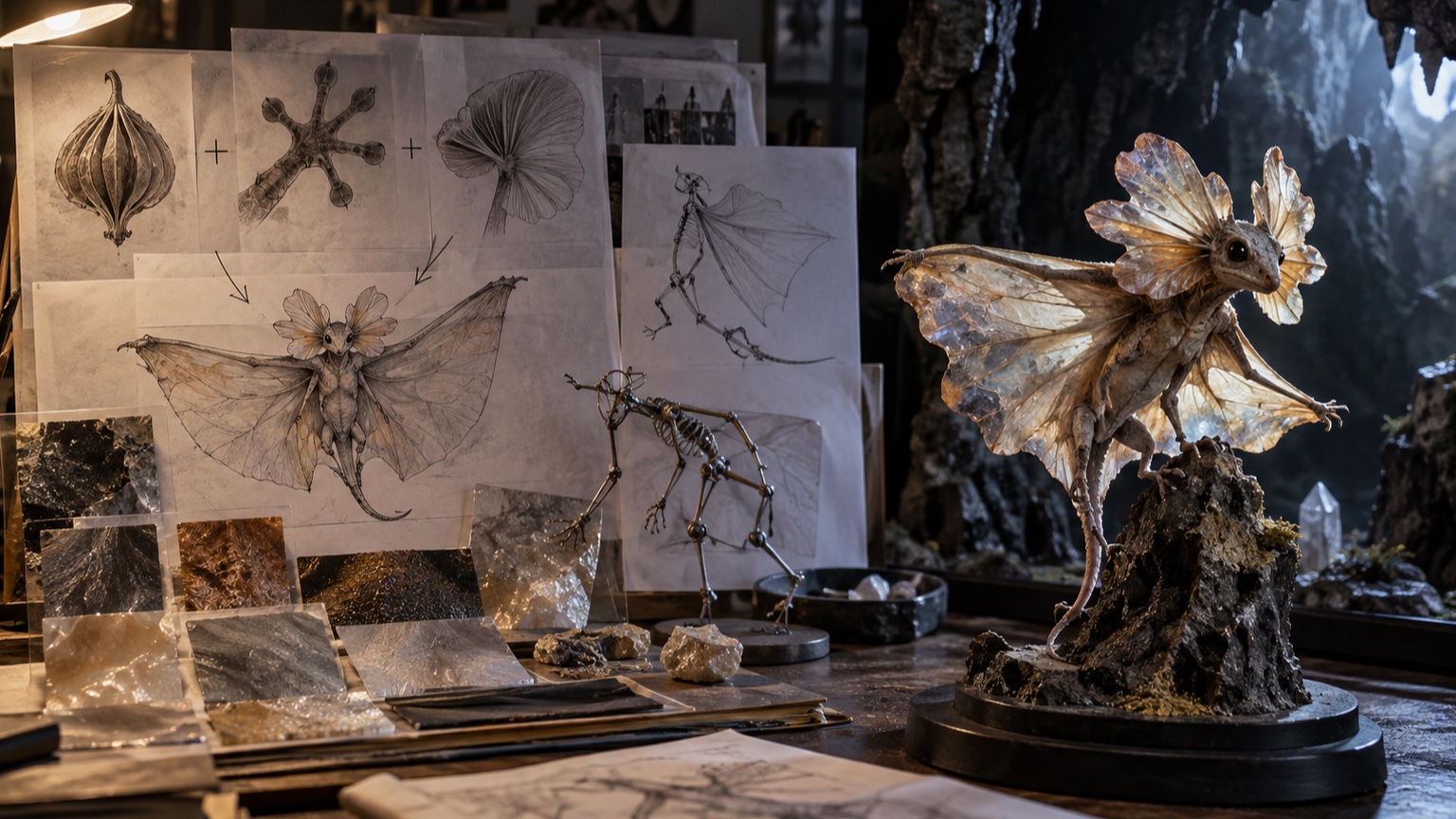
Transfer a function into anatomy that fits the new body plan. A seed’s passive rotation might become coordinated membrane twisting. A flower’s opening sequence might inspire sensory fins that deploy from front to back, but their hinges, tissue, and behavior should belong to the creature.
Change scale and medium. A microscopic filter can become a large ribbed organ, but gravity, support, damage, and cleaning now matter. A rigid architectural lattice translated into flexible tissue needs joints or graded material. Following those changes moves the concept away from literal reference.
Combine processes rather than visible parts. Pair how roots grip fractures with how gliding animals shift center of pressure. The result may be a foot-to-wing coordination system instead of an animal wearing plant-shaped decoration.
Add a Constraint That Removes the Obvious Answer
Productive constraints make easy clichés unavailable. Forbid powered flight, forward-facing vision, rigid armor, vocal sound, or more than four contact points. Require the creature to keep one limb attached while moving or to store every display surface within the resting silhouette. The constraint should relate to world or production, not exist as a puzzle with no consequence.
Generate Truly Different Body Plans
Draw small structural diagrams before detailed silhouettes. Change where the spine bends, how mass is supported, which appendages touch the environment, and how the creature folds. One plan might suspend between two grip points; another climbs as a compact quadruped and deploys the torso; a third moves through coordinated membrane tension.
Label each plan with advantages, costs, and characteristic actions. Rejecting a plan because it is difficult is premature if the difficulty produces the most distinctive behavior. Reject it when the cost overwhelms the story, ecology, or production needs.
Choose two finalists and develop them to the same level. A polished favorite will always defeat rough alternatives unfairly. Compare them using niche fit, silhouette, movement potential, emotional effect, originality risk, and buildability.
Trace Every Major Consequence
Large sensory fins change weight, drag, heat loss, protection, grooming, social signaling, and resting shape. Adhesive feet affect gait, release timing, debris, moisture, sleep, and juvenile learning. For each major feature, draw a consequence map across anatomy, behavior, environment, and performance.
Use costs to deepen the concept. Fragile membranes might force careful route planning. Bright mineral surfaces may improve communication but attract predators. A specialized diet may require long dormant periods. Limitations generate scenes and distinguish the creature from an all-purpose fantasy animal.
Trace failure and recovery. What happens when a membrane tears, a foot becomes contaminated, or a sensor overloads? Scar patterns, compensating posture, help from group members, and seasonal repair can become memorable visual evidence.
Consider development. Juveniles may have different proportions, surfaces, and movement because structures have not matured. A feature that changes through life feels less like an accessory and more like part of the organism.
Find the Signature Relationship
Reduce the concept to one sentence describing a visible relationship: “gripping hind feet anchor a compact body while petal-like fins read the air and control descent.” That relationship should remain clear as pose, angle, color, and detail change. It is the concept’s structural identity.
Do not confuse a signature relationship with a logo-shaped feature. The fins matter because sensing, movement, vulnerability, and social display meet there. Their outline can evolve without losing the concept.
Design Transitional Anatomy
Invent how unlike materials and body regions meet. Show membrane folding into a reinforced edge, sensory fibers emerging through protective scales, or adhesive pads transitioning into weight-bearing toes. Transitional anatomy removes the cut-and-paste feeling common to mashups.
Create Behavior No Reference Owns
Combine the creature’s systems into a sequence. It may anchor one hind foot, open the front sensory fin to read airflow, shift body mass, release, glide, rotate the fins during descent, and land by reversing the deployment order. The complete behavior belongs to the new concept even though individual principles have precedents.
Design ordinary routines too. Feeding on condensation, cleaning adhesive pads with mineral dust, sheltering fins during rockfall, and exchanging air pulses with group members make the animal specific. Originality is easier to sustain across a life than inside one hero pose.
Use behavior to reveal features gradually. A folded creature can appear compact and cautious. Deployment changes both scale and emotional reading. The transformation becomes a memorable event because the anatomy has a reason to open.
Control Surface and Color
Let material strategy follow habitat. Translucent membranes may contain branching supports and show damage. Gripping surfaces may be matte and debris-sensitive. Mineral-toned plates may grow in layers rather than appear as random crystal spikes. Separate protective, flexible, sensory, and display zones.
Test the design without its palette. If originality disappears in grayscale silhouette, color is carrying too much. Then restore color as environmental and behavioral information: changing translucency, wear at contact points, internal flow, or display revealed during motion.
Check for Accidental Resemblance
Compare the finalists with the reference board and a wider search set. Examine silhouette, head structure, appendage arrangement, signature pose, palette, and story function together. A shared individual feature may be common; a cluster of matching relationships deserves revision. Keep dated sketches and influence notes to document independent development.
Prototype in Motion and Volume
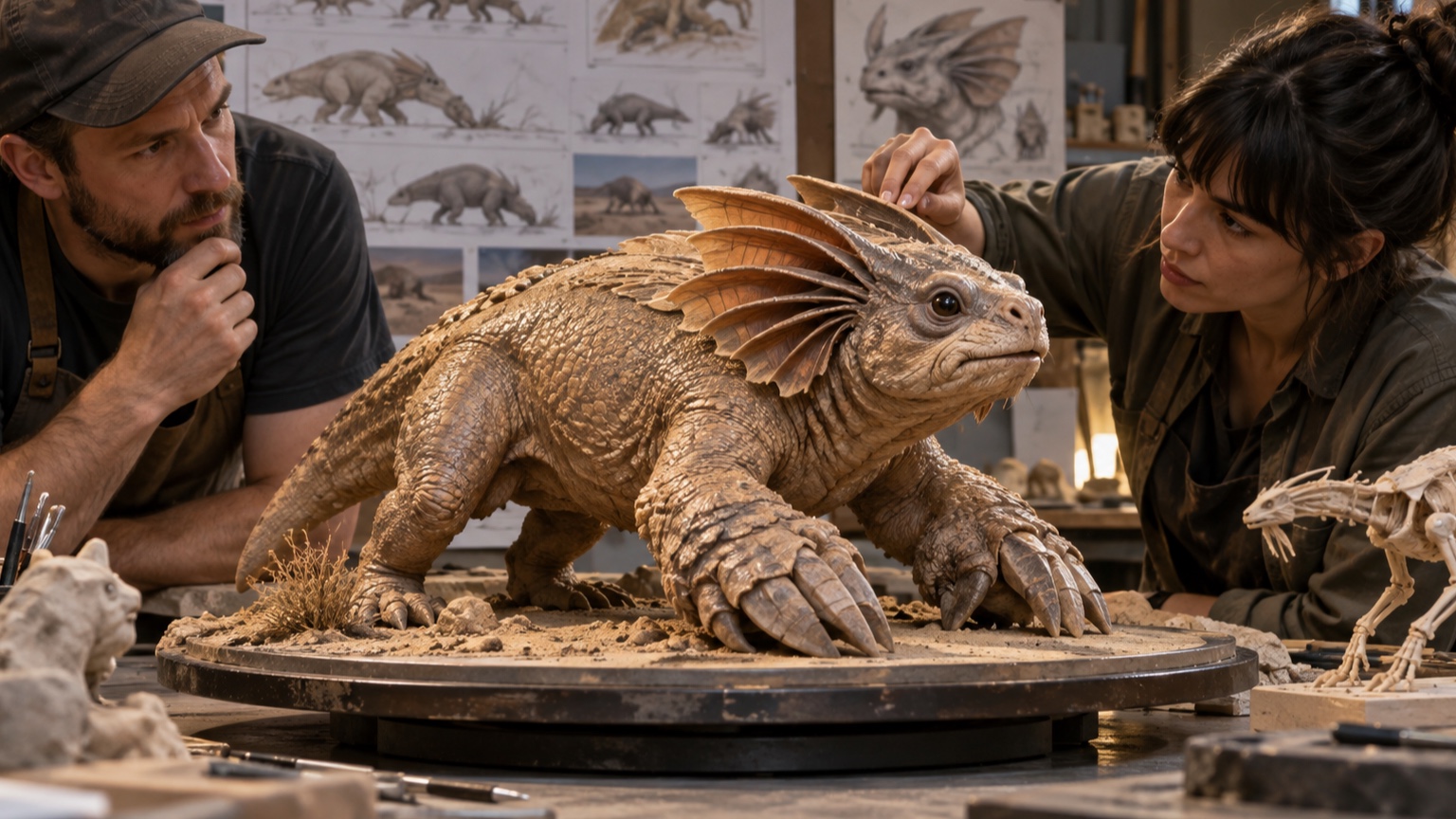
Build a wire or card model that can fold, grip, open, and land. A static illustration may conceal impossible storage or collisions. Turn the model under a single light to inspect silhouette change and translucent behavior. If intended for animatronics or puppetry, identify actuator, performer, cable, support, and service volumes while the concept remains flexible.
Film a simple motion test with deliberate timing. Evaluate whether the signature relationship reads without narration. Remove unnecessary steps, protect vulnerable transitions, and find the pause where audiences understand the change. Sound can support airflow, grip release, and membrane tension without imitating familiar animal calls.
Place the prototype in a rough environment at correct scale. Terrain reveals whether contact points, clearance, and navigation make sense. It also shows whether the creature remains visually distinct from the mineral shapes that inspired it.
Select the Concept With Evidence
Score finalists against the original problem, emotional role, recognizable silhouette, connected consequences, behavioral potential, originality risk, and production feasibility. Weight the criteria according to the project rather than pretending all are equal. Define what evidence supports each score: silhouette comparison, motion test, material sample, reference review, engineering sketch, audience response, or cost estimate. A number without evidence can disguise preference as objectivity. Invite each discipline to identify the concept risk it is best equipped to see, then distinguish a solvable implementation problem from a contradiction in the central idea. Ask reviewers to describe how the creature lives and moves before explaining it. Repeated accurate inference shows the design is communicating. Unexpected but useful interpretations may improve the concept; repeated confusion points to relationships that need clarification. Conduct a delayed recall check as well. Show the options briefly, remove them, and ask for a description or quick sketch later. Note whether reviewers remember the signature relationship, a generic category cue, or only the palette. Compare responses across people unfamiliar with the development process and collaborators who know the brief. Both perspectives reveal different blind spots.
Commit to one approved direction and record why. Continue revising consequences rather than restarting from novelty whenever doubt appears. A unique creature concept becomes stronger when the team protects its central problem and signature relationship while allowing anatomy, materials, and performance to mature. Create a short protection statement naming the body relationship, behavior sequence, and environmental dependency that cannot disappear without changing the concept. Mark secondary features as flexible. This boundary helps later production teams simplify responsibly and prevents surface polish from slowly replacing the idea that made the creature distinct. Archive the concept matrix, dated iterations, motion tests, and final influence map with that decision. Together they preserve both the reasoning and the path of independent development for future revisions. Keep the approved comparisons with them.