A modern animatronic does not come to life because one clever motor pulls one hidden wire. It comes to life because many quiet systems agree with one another at the same moment. A rigid frame gives the figure a body, actuators supply force, sensors report what is happening, controllers decide what should happen next, and the outer skin turns all of that engineering into a face, creature, mascot, or museum character that an audience can believe in. The magic is not a single part. It is the choreography between parts.
A: It is a coordinated set of structure, actuators, controls, sensors, software, and surface materials that creates a physical character performance.
A: They overlap, but animatronics is usually designed around believable character motion and show presentation rather than general-purpose tasks.
A: No single part does it. The lifelike effect comes from timing, motion paths, surface response, and coordinated behavior.
A: No. Fixed show figures may use limited feedback, while interactive or safety-critical systems need more sensing.
A: A prototype reveals whether the visible motion feels right before time and money go into final parts.
A: Facial movement is often hardest because viewers notice tiny errors in eyes, eyelids, lips, and timing.
A: Usually no. Actuator choice depends on load, leverage, speed, duty cycle, and safety margin.
A: Soft material stretches, resists movement, wrinkles, and can change how much travel the mechanism needs.
A: The controller follows timed motion cues, recorded puppeteering, or software profiles matched to the audio track.
A: Good access, proper wiring, heat management, tested motion limits, documentation, and parts chosen for repeated operation.
The Character Starts as a Mechanical Promise
Every animatronic system begins before anyone buys a servo or cuts a bracket. It begins with a promise about what the character must appear to do. A small tabletop figure might only need to blink, nod, and turn toward a visitor. A full-size show character may need to breathe, gesture, shift weight, curl fingers, and speak in time with audio. Those performance goals decide almost everything that follows, because animatronics is not general robotics with a costume added at the end. It is robotics built around a performance illusion.
The design team usually translates that illusion into motions. Instead of saying the character should be friendly, they ask what friendly looks like in mechanical terms. Does the head tilt a little before the eyes move? Does the jaw open smoothly or snap with comic timing? Does the chest rise when the figure pauses? Each visible behavior becomes a motion requirement, and each motion requirement becomes a mechanical problem with limits. The system has to move far enough to read from the audience area, but not so far that the skin wrinkles badly, the mechanism binds, or the character looks unnatural.
The Frame Gives the Robot a Body
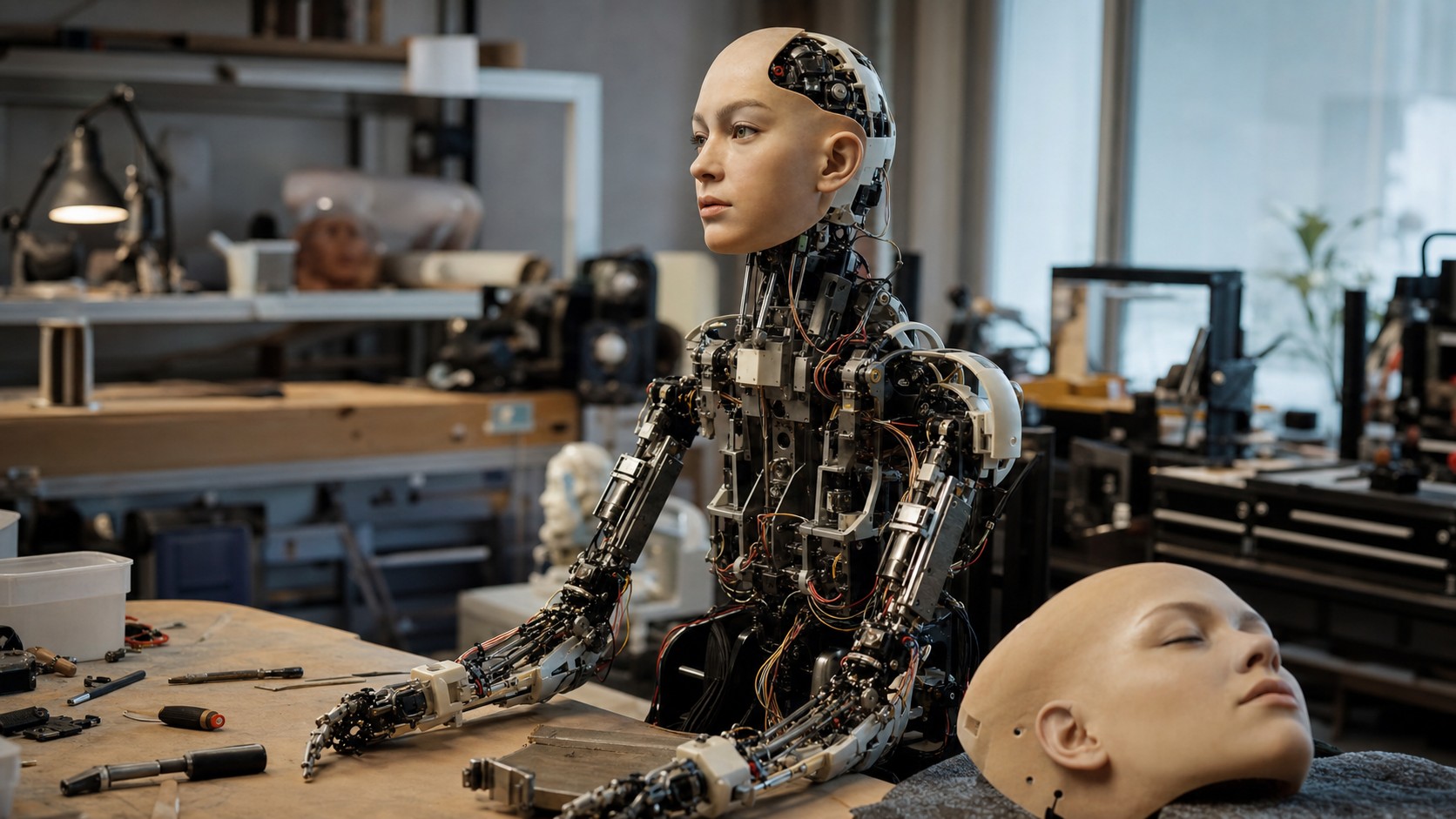
The internal frame is the skeleton of the animatronic. It holds the actuators, protects wiring, defines the pose, and gives every moving part a reliable reference point. In a small display figure, that frame might be aluminum plate, 3D printed joints, and simple standoffs. In a large figure, it may be welded steel, machined aluminum, composite panels, and service doors placed where technicians can reach them quickly. The frame is not glamorous, but it is the difference between a character that performs for years and a character that slowly shakes itself apart.
A good frame is stiff where precision matters and forgiving where maintenance matters. The eye mechanism, for example, needs alignment because tiny errors are easy to see in a face. A shoulder assembly may need stronger load paths because arms create leverage. Access panels need to open without removing half the costume. Cable channels need space for motion, strain relief, and future repair. If the frame is treated as an afterthought, every later system pays for it. Motors run hotter, skins tear sooner, and technicians spend too much time reaching around parts that should have been arranged with service in mind.
Actuators Turn Commands into Force
Actuators are the muscles of an animatronic system. They convert electrical, pneumatic, or hydraulic energy into motion. Small figures often use electric servos because they are compact, predictable, and easy to control. Larger figures may use linear actuators, brushless motors with gearboxes, pneumatic cylinders, or hydraulic systems when the motion needs more force. The choice is never only about strength. Designers also care about speed, noise, smoothness, heat, duty cycle, cost, and how the actuator behaves if power is lost.
One of the most common beginner mistakes is choosing an actuator because it can move the part once on a workbench. Real animatronics asks a harder question: can it move the part repeatedly, quietly, safely, and at the right speed while hidden inside the character? A jaw actuator may not need much torque, but it needs clean timing. An eyelid actuator needs small, graceful motion without jitter. A body lean may need high force and slow acceleration so the figure feels heavy instead of twitchy. The best actuator is the one that makes the performance believable while staying within the physical limits of the machine.
Linkages Shape the Motion the Audience Sees
Motors rarely connect directly to the visible surface. Between the actuator and the character is a motion transmission: linkages, cables, gears, cams, belts, rods, or flexures that shape force into the desired path. This is where animatronics becomes wonderfully physical. A rotating servo can become a raised eyebrow. A short linear stroke can become a wide mouth movement. A cable can pull a cheek, a lever can lift a lip, and a cam can make a repeatable gesture with a particular personality.
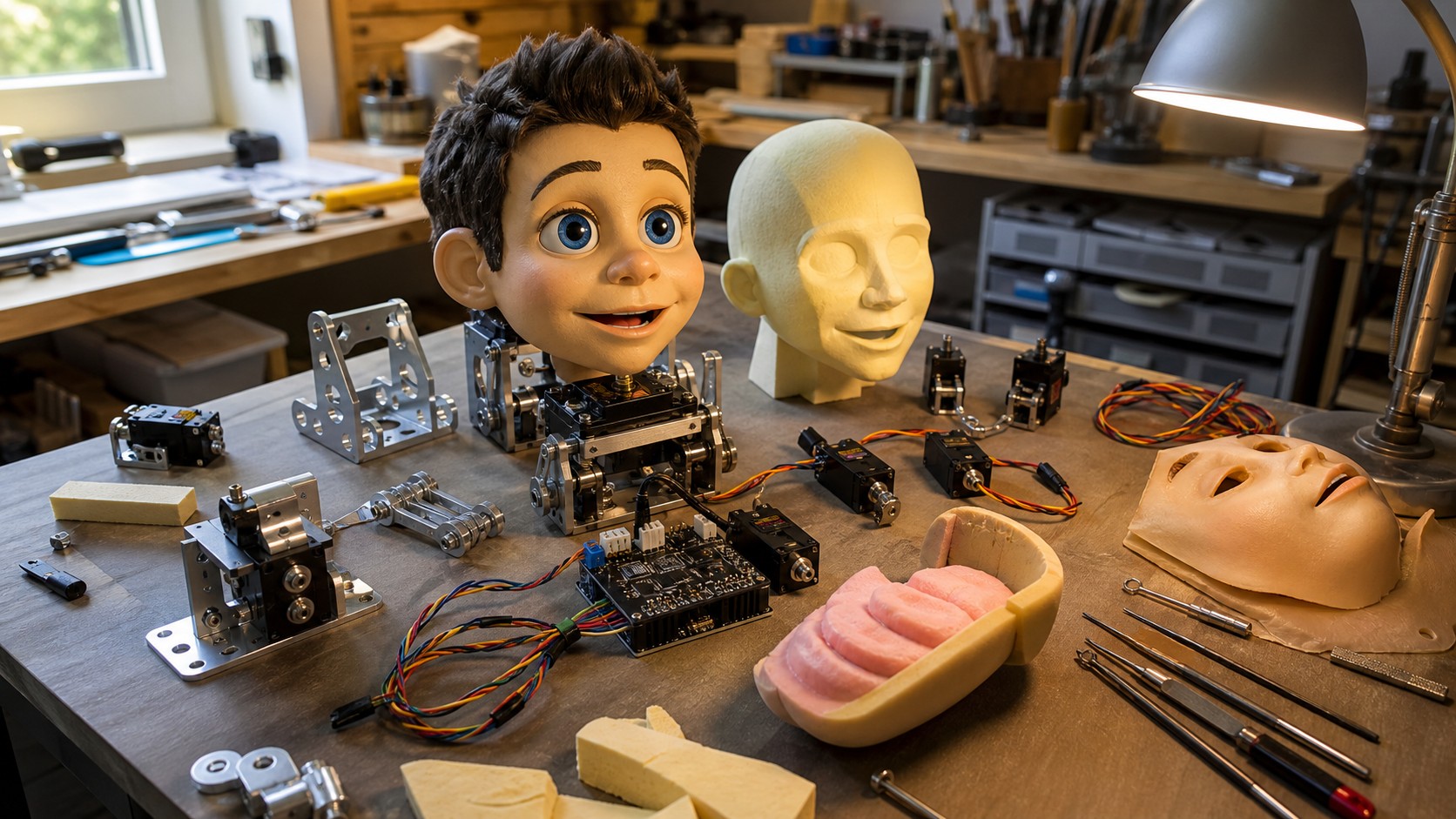
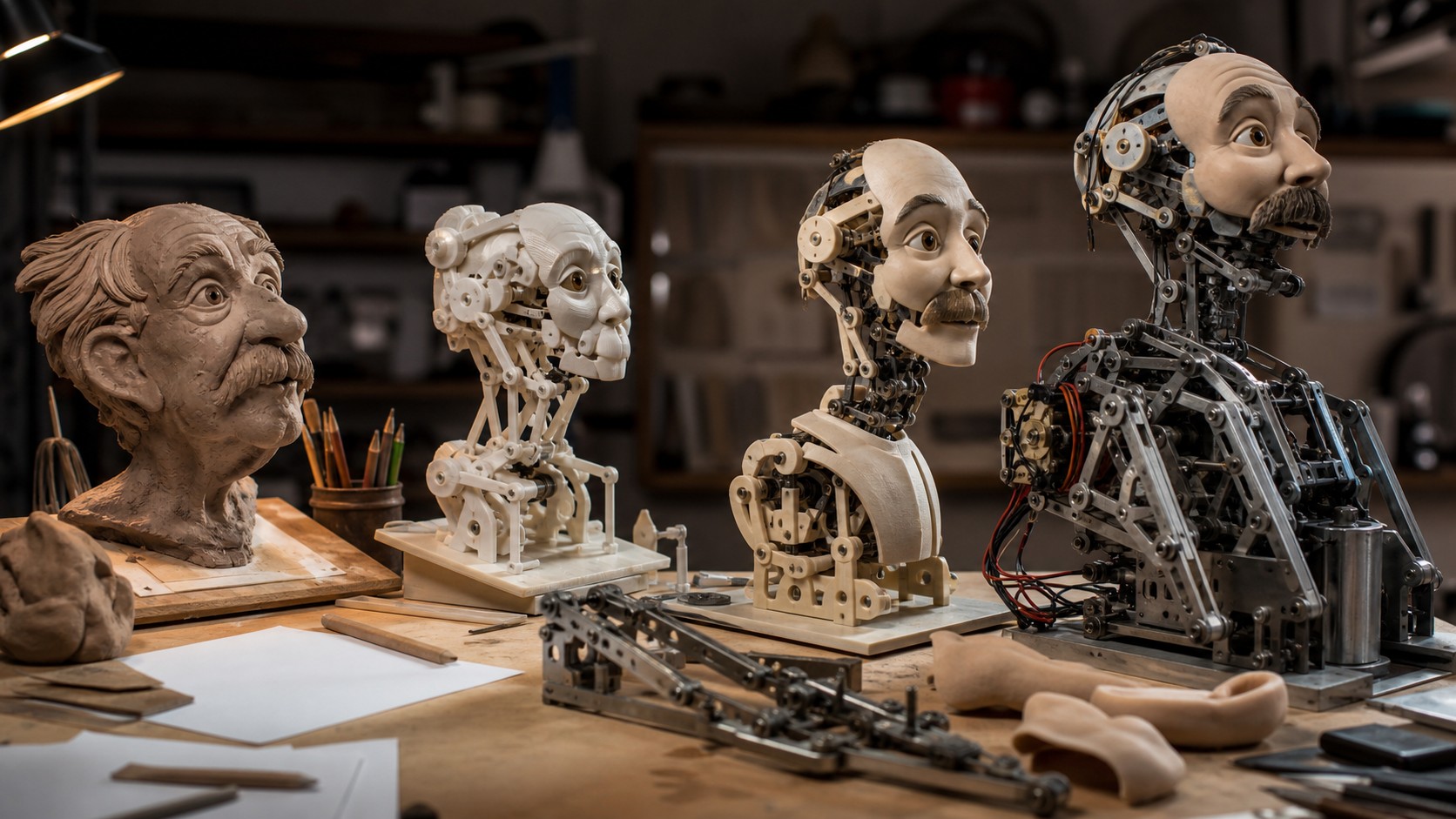
The transmission matters because audiences do not see motor rotation; they see expression. The same actuator can look mechanical or lifelike depending on the linkage geometry. If a jaw opens on the wrong arc, it may look like a hinged toy. If the cheeks, lips, and jaw move together with the right timing, the same basic motion can suggest speech, breath, or emotion. This is why experienced builders often prototype mechanisms in rough form before committing to final parts. Cardboard, plywood, printed test pieces, and temporary rods can reveal whether a motion feels alive long before the expensive version is built.
Sensors Help the System Know Itself
Some animatronics play a fixed show and do not need much feedback beyond basic position control. Others need sensors so the system can understand its own state or respond to people nearby. Encoders can report motor position. Limit switches can confirm that a mechanism has reached a safe end point. Current sensing can warn that something is jammed. Proximity sensors can detect a visitor. Microphones, cameras, and pressure mats can be used in interactive installations, though they add complexity and must be handled thoughtfully.
Feedback is valuable because the real world is messy. A skin may become stiffer in a cold room. A linkage may loosen slightly after thousands of cycles. A child may stand closer to an exhibit than expected. Sensors let the controller adjust, pause, reset, or trigger a different behavior. They also help technicians diagnose problems before a failure becomes dramatic. A system that knows a motor is drawing too much current can stop before a gear strips. A system that knows a homing switch failed can refuse to start a show sequence. That kind of caution is part of professional animatronic design.
The Controller Is the Nervous System
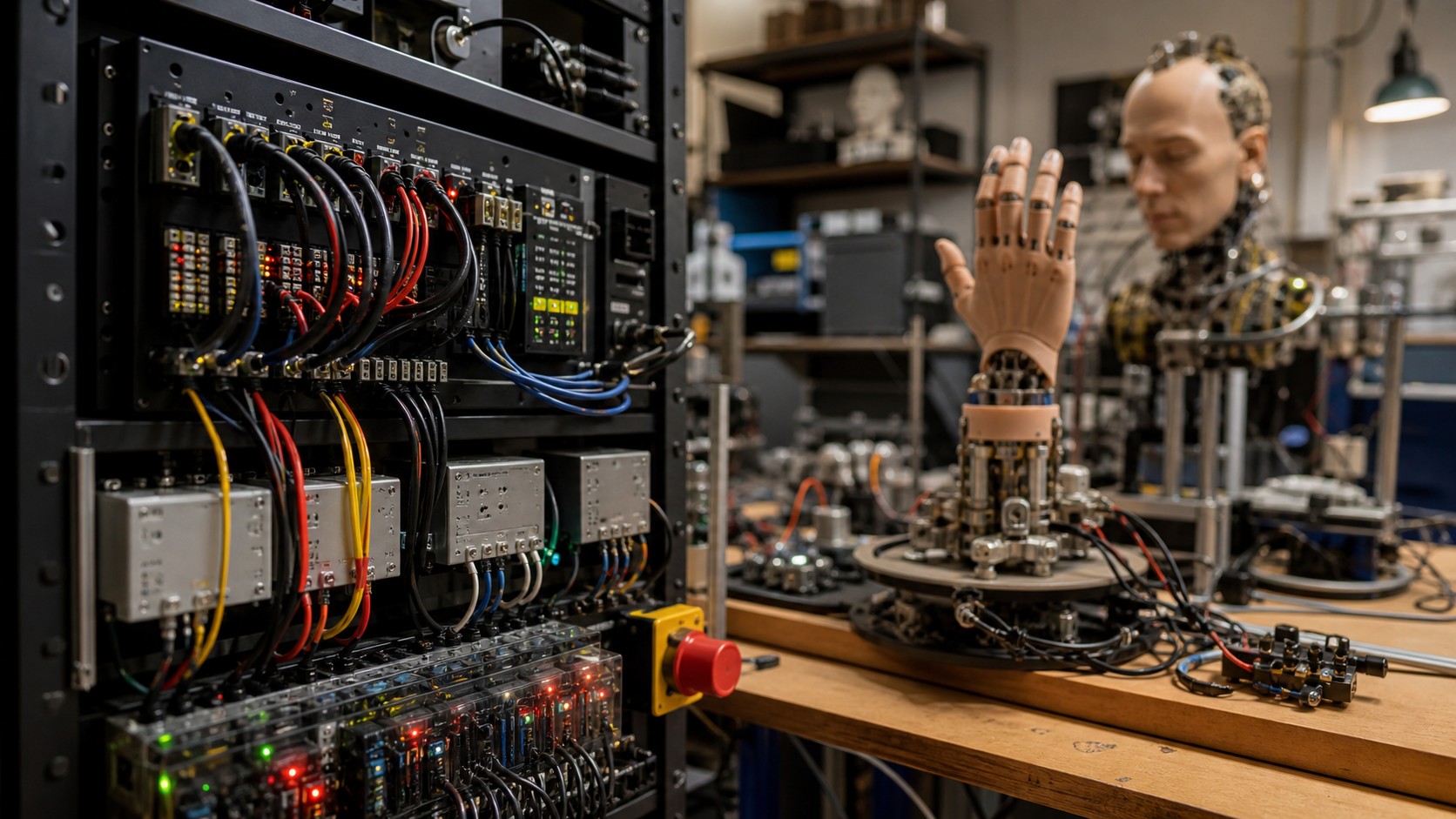
The controller coordinates the entire performance. It may be a simple microcontroller running a few servos, an industrial PLC managing heavy equipment, a show-control computer sending timed cues, or a network of specialized boards that divide the work. Its job is to receive commands, interpret timing, drive actuators, read sensors, and keep the figure inside safe operating limits. In a polished installation, the controller also communicates with audio, lighting, safety systems, and sometimes a larger attraction or exhibit network.
Timing is where the controller earns its place. A blink that arrives half a second late can make a character feel vacant. A mouth movement that does not match the audio breaks the illusion immediately. A hand gesture that starts before the head turns can feel unnatural. Controllers allow builders to tune these relationships with precision. Some systems use recorded motion profiles, some use keyframes like animation software, and some blend scripted motion with live inputs. No matter the method, the goal is the same: make mechanical action feel intentional.
Software Turns Motion into Performance
Software gives animatronics its repeatable behavior. A designer can define positions, speeds, acceleration curves, pauses, and transitions. That last part is important. Living things rarely move at one constant speed. They anticipate, ease in, hesitate, recover, and settle. If an animatronic head rotates at a perfectly even rate, it looks like a machine. If it begins with a tiny delay, accelerates gently, lands slightly before the eyes refocus, and then relaxes, it begins to feel aware.
Modern tools can make this process more approachable. Some teams animate motions on a timeline. Others use puppeteering interfaces that record live control input. Advanced systems may include procedural behaviors so a figure can idle, glance, breathe, or react without repeating the exact same sequence every time. The trick is restraint. Random motion is not the same as lifelike motion. A good behavior system adds variation while preserving character. The figure should seem alive, not restless.
Skin and Surface Sell the Illusion
The outer surface is where engineering meets sculpture. Silicone, latex, foam, fabric, fiberglass, fur, paint, and hair all change how a motion reads. A mechanism that looks perfect without skin can fail once the skin is installed, because soft materials resist motion, wrinkle, stretch, and dampen small details. Builders must consider thickness, elasticity, attachment points, and how the skin will age. A smiling cheek needs the right pull under the surface. An eyelid needs enough flexibility to close smoothly without folding in the wrong place.
Surface finishing also affects audience trust. Subtle texture can make skin catch light naturally. Paint layers can suggest translucency, wear, or warmth. Hair placement can hide seams and soften transitions. Even a nonhuman creature needs visual logic. If the audience believes the surface belongs to the body, they are more willing to believe the motion beneath it. That is why the mechanical team and the art team cannot work in isolation. The mechanism creates movement, but the surface gives that movement meaning.
Power, Wiring, and Heat Stay Hidden but Critical
Behind every smooth performance is a practical support system. Power supplies must handle peak loads without sagging. Wiring must flex without breaking. Connectors must be labeled, strain-relieved, and accessible. Heat must escape from motors, drivers, and electronics. These details may not appear in promotional photos, yet they often decide whether an animatronic is dependable. A character that works for five minutes in a studio is not the same as a character that performs all day in a public venue.
Professional systems are designed with maintenance in mind. Cable bundles follow predictable paths. Boards are mounted where they can be inspected. Fuses and emergency stops are not buried. Components that wear out are replaceable. Documentation matters too, because the person repairing the figure six months later may not be the person who built it. Good animatronics respects the future technician. That respect shows up as fewer surprises, quicker repairs, and less downtime.
Safety Defines the Edges of the Show
Animatronics often appears playful, but the machinery can be powerful. Moving arms, closing jaws, rotating platforms, and heavy bodies require safety planning. Designers think about pinch points, emergency stops, speed limits, soft limits in software, hard stops in hardware, and what happens during power loss. Public installations require even more care because visitors may behave unpredictably. A safe system assumes that someone will stand too close, touch the wrong area, or interrupt the expected sequence.
Safety does not have to make a figure dull. It simply sets the envelope inside which creativity can operate. A well-designed character can look energetic while keeping dangerous motion away from guests. It can use compliant surfaces, guarded mechanisms, torque limits, and carefully staged choreography. The best safety systems are almost invisible to the audience, but they are never absent. They are part of the reason the illusion can be enjoyed without anxiety.
Testing Is Where the Robot Learns to Perform
No animatronic emerges perfect from assembly. Testing reveals the difference between the design in the computer and the machine in the room. Builders run motion cycles, listen for unexpected noise, watch for rubbing skin, measure heat, adjust timing, and look for movements that feel wrong. Sometimes the fix is mechanical: shorten a linkage, stiffen a bracket, reroute a cable. Sometimes it is artistic: slow a blink, soften a jaw close, add a pause before a turn.
This stage can be humbling because lifelike motion is sensitive to small details. A few degrees of eye movement can change a face from attentive to eerie. A shoulder that starts too abruptly can make a body seem weightless. A repeated idle motion can become distracting if it lacks variation. Testing gives the team a chance to tune the performance until the engineering disappears from the audience’s attention. The viewer should notice the character, not the actuator doing its job.
The Life Is in the Agreement Between Systems
Modern animatronics comes to life when all of these systems agree. The frame holds alignment. The actuators provide controlled force. The linkages translate that force into expressive paths. The sensors protect and inform the machine. The controller coordinates timing. The software shapes personality. The skin and finish make the motion believable. None of these pieces is enough alone, and that is exactly what makes animatronics so fascinating.
When a finished figure turns its head, blinks, breathes, and reacts, the audience may call it magic. The builder knows it is a long chain of decisions working in harmony. That does not make the moment less magical. In many ways it makes it more impressive. Animatronics is the art of hiding careful engineering inside a believable presence. The robot comes to life not by escaping the machine, but by making the machine serve a character.