What Makes an Animatronic Look Uncanny—or Believable
Animatronics occupy a fascinating space between machinery and life. At their best, they evoke emotion, empathy, and wonder, convincing audiences that a fabricated being has genuine presence. At their worst, they trigger discomfort—a subtle, instinctive rejection known as the uncanny effect. Understanding why some animatronics feel alive while others feel unsettling is both an art and a science, rooted in psychology, biomechanics, design, and storytelling. The difference between uncanny and believable is rarely a single flaw; it is almost always the accumulation of small choices working either in harmony or in conflict.
A: They approach realism without fully achieving natural motion cues.
A: Yes—eye motion and focus dominate human perception.
A: No—over-smoothing removes organic variation.
A: Mechanical noise strongly impacts realism.
A: Often—perfect symmetry feels artificial.
A: Yes—they suggest awareness and life.
A: Absolutely—stylization avoids uncanny thresholds.
A: In many cases, yes.
A: Humans subconsciously detect repetition.
A: Chasing perfection instead of life-like imperfection.
The Psychology Behind the Uncanny Effect
The concept most often associated with discomfort in lifelike machines is the “uncanny valley,” a term introduced by Japanese roboticist Masahiro Mori. It describes how human affinity for artificial beings increases as they become more humanlike—until a sudden drop occurs when they are almost, but not quite, real. Animatronics often live dangerously close to this threshold.
Human perception is finely tuned to detect subtle irregularities in faces and movement. Evolution trained our brains to read micro-expressions, eye focus, muscle tension, and timing as indicators of intent and emotion. When an animatronic mimics these cues imperfectly, the brain registers a contradiction: the object looks human, but behaves incorrectly. This cognitive dissonance is what creates unease. Believability, therefore, is not about realism alone, but about internal consistency with human expectations.
Facial Proportions and the Limits of Realism
One of the most critical factors in animatronic believability is facial proportion. Humans are extraordinarily sensitive to facial symmetry, eye spacing, jaw alignment, and skin tension. Even millimeter-level inaccuracies can be subconsciously detected. When an animatronic face is sculpted too close to human anatomy without achieving near-perfect accuracy, it often feels wrong.
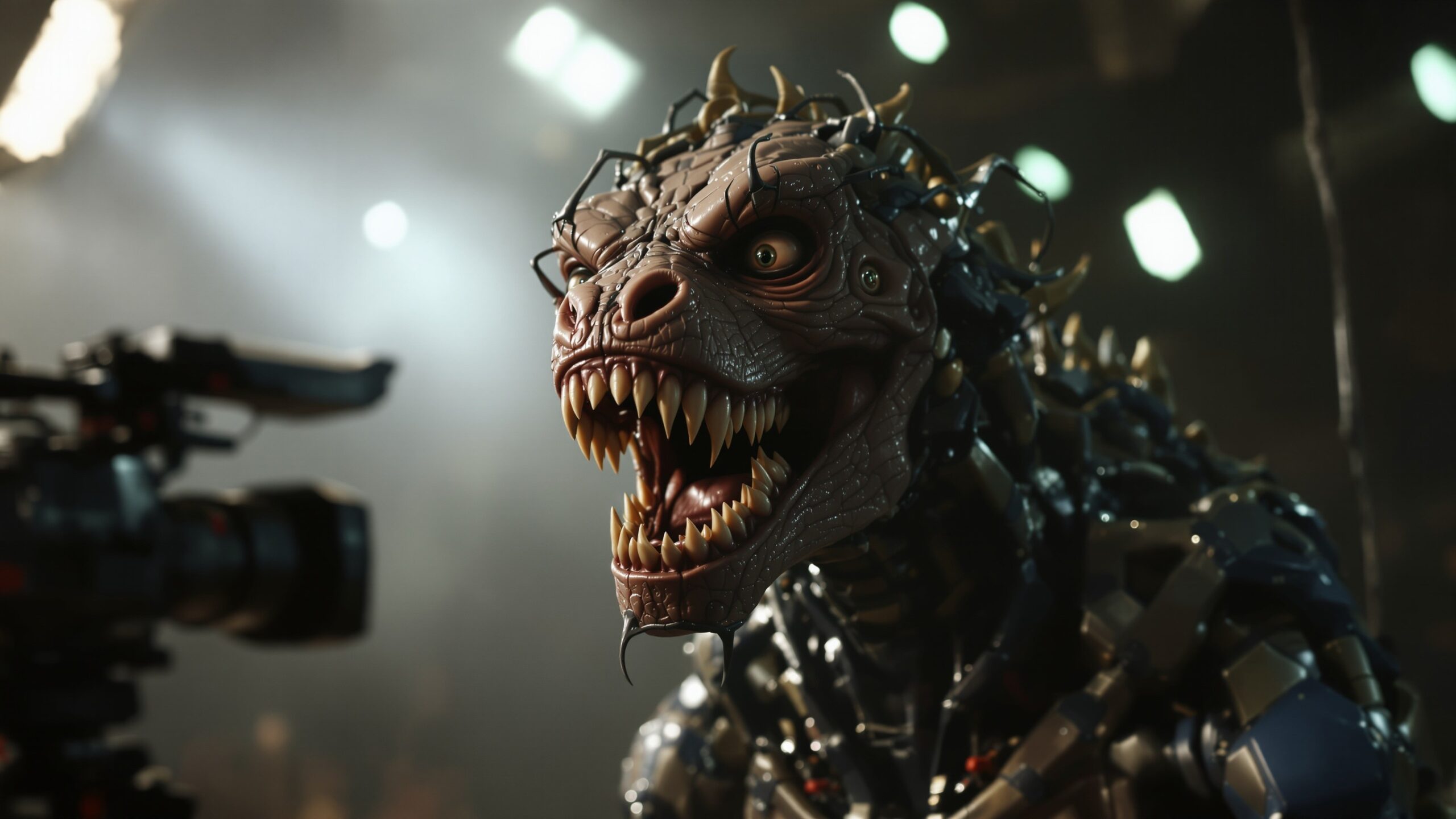
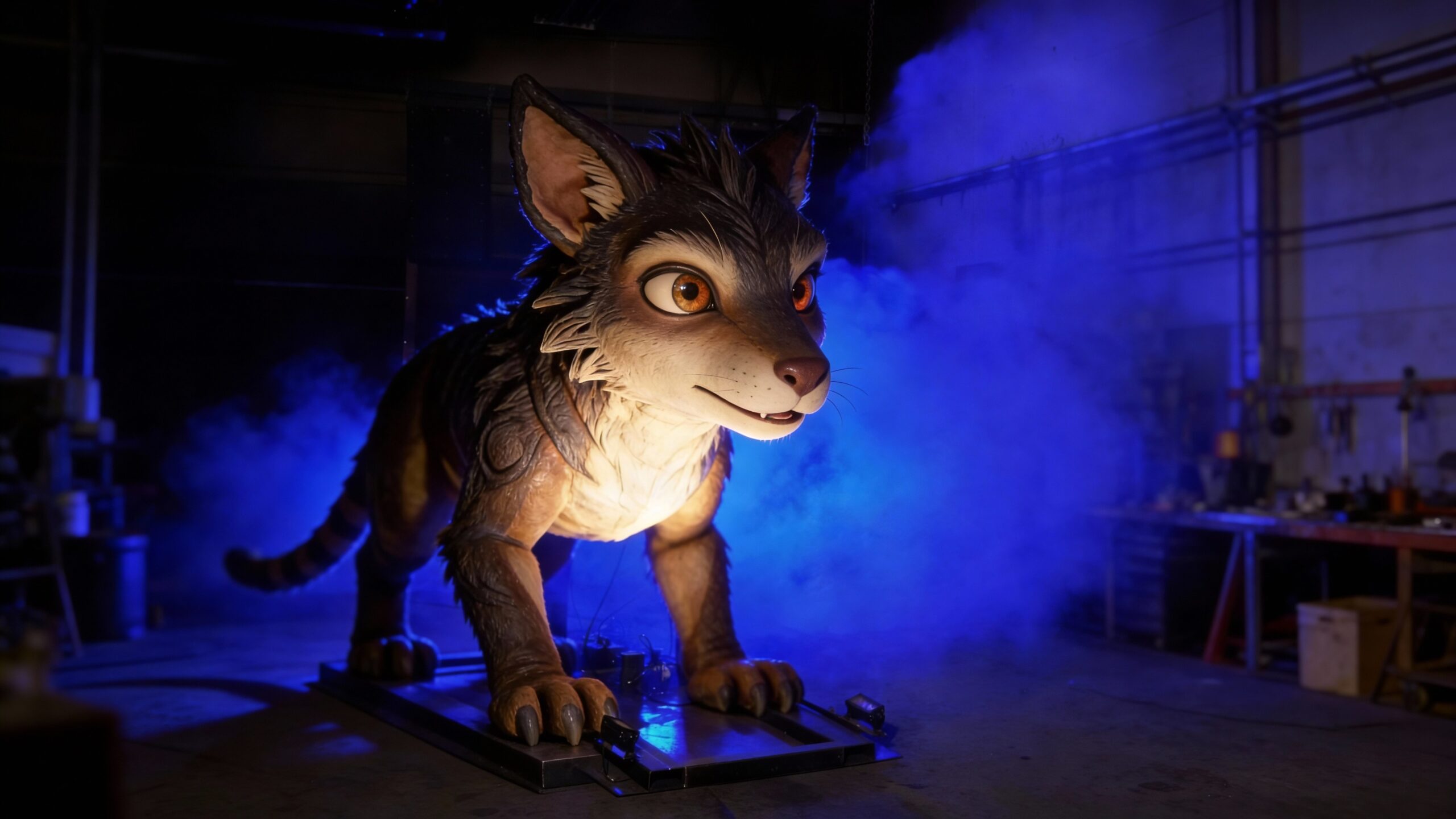
Ironically, stylization frequently enhances believability. Many successful animatronics lean slightly away from strict realism, exaggerating or simplifying features in a way that gives the audience’s brain permission to suspend disbelief. When a face is clearly stylized, viewers judge it by different standards. When it is hyper-realistic, they judge it as a human—and it almost always fails that test.
Eye Design: The Gateway to Life
Eyes are often cited as the single most important element in whether an animatronic feels alive. Humans instinctively seek eye contact, interpret gaze direction, and read emotion through eye movement. If the eyes of an animatronic are lifeless, misaligned, or improperly animated, the illusion collapses immediately.
Believable animatronic eyes require more than accurate shape and color. They need subtle asymmetry, micro-movements, natural blinking patterns, and appropriate focus shifts. A perfectly synchronized blink or a stare that never quite locks onto a subject can feel deeply unsettling. Successful designs introduce imperfection: slight delays, varied blink intervals, and gentle eye drift that mimics how living beings constantly adjust their gaze.
Motion Timing and Biological Rhythm
Movement is where many animatronics succeed or fail. Humans move with complex acceleration and deceleration patterns driven by muscles, tendons, and gravity. Mechanical systems, by contrast, tend to move in linear, predictable ways. When animatronic motion is too smooth, too fast, or too evenly timed, it reveals its artificial nature.
Believable animatronics incorporate biological rhythm. Head turns begin with a lead-in, pause briefly at their apex, and settle naturally. Facial expressions bloom gradually rather than snapping into place. Even breathing, whether visible or implied, adds rhythm and grounding. The absence of these timing nuances is one of the strongest contributors to the uncanny effect.
Skin, Texture, and Material Behavior
The surface of an animatronic is as important as what lies beneath it. Human skin is translucent, layered, and dynamic. It stretches, compresses, reflects light unevenly, and changes subtly with movement. Synthetic skins that are too uniform, too glossy, or too stiff immediately betray the illusion.
Believable animatronic skin often uses layered silicone systems designed to mimic epidermis, dermis, and subdermal structures. Color variation, vein hints, freckles, and slight imperfections add realism. Equally important is how the skin behaves during motion. If it fails to wrinkle, slide, or compress naturally over underlying structures, the animatronic will feel rigid and false regardless of how accurate it looks at rest.
The Role of Micro-Expressions
Micro-expressions—tiny, involuntary facial movements—are a hallmark of living beings. They convey emotion subconsciously and constantly. Humans rarely hold a perfectly neutral face; there is always slight tension around the eyes, mouth, or brow. Animatronics that remain frozen between programmed expressions feel dead, even if their major movements are impressive.
Advanced animatronics introduce low-level motion layers: subtle eyebrow shifts, minor lip tension changes, faint cheek movement, or slow posture adjustments. These micro-movements keep the character visually “thinking,” preventing the eerie stillness that triggers discomfort. Believability emerges not from dramatic action, but from continuous, almost unnoticeable life signals.
Sound, Voice, and Synchronization
Audio plays a powerful role in shaping perception. A believable animatronic must have sound that matches its physical presence. If the voice is too clean, too loud, or poorly synchronized with mouth movement, the illusion fractures. Humans are exceptionally good at lip-reading and detecting mismatches between sound and motion.
Timing is everything. Natural speech includes hesitation, breath sounds, uneven pacing, and emotional inflection. Animatronics that speak with perfect rhythm or exaggerated clarity can feel artificial. Even silent animatronics benefit from environmental sound cues—mechanical whirs subtly masked, breathing effects, or ambient noise that grounds the character in its setting.
Context and Environmental Framing
An animatronic does not exist in isolation. Its believability is heavily influenced by the environment and narrative context in which it appears. Lighting, distance, framing, and audience expectation all shape perception. A figure that looks convincing in dim, theatrical lighting may feel unsettling under bright, clinical illumination.
Theme parks, museums, and film sets use controlled environments to enhance realism. Strategic shadows soften imperfections. Set dressing provides scale references. Narrative framing tells the audience what kind of being they are encountering. When context aligns with design, audiences are more forgiving and more engaged. When context contradicts appearance, even excellent animatronics can feel uncanny.
Character Design and Emotional Clarity
Believability is not only about realism; it is about emotional clarity. Audiences need to understand what a character is supposed to be feeling. Conflicting cues—such as a smiling mouth with lifeless eyes, or friendly dialogue paired with stiff posture—create unease.
Strong animatronic design begins with character intent. Is the figure meant to be warm, mysterious, intimidating, or whimsical? Every design decision, from eyebrow shape to motion speed, should reinforce that intent. When emotional signals are consistent, audiences connect. When they are mixed, the uncanny effect emerges.
Mechanical Constraints and Creative Solutions
Animatronics are limited by physics, durability, and maintenance needs. Designers must work within constraints such as actuator size, load limits, and wear over time. The uncanny effect often appears when designers push realism beyond what the hardware can reliably support.
Believable animatronics embrace constraint-driven creativity. Instead of forcing full facial realism, designers may prioritize expressive eyes and mouth while simplifying other areas. Instead of rapid motion, they use slower, deliberate gestures that feel intentional. By aligning ambition with mechanical capability, the illusion remains intact.
Aging, Wear, and Long-Term Realism
Even the most convincing animatronic can drift into uncanniness over time. Skin degrades, motion loosens, calibration shifts, and timing drifts. Humans are adept at noticing decay in living things, and when artificial beings age unnaturally, the effect can be unsettling.
Professional maintenance focuses not just on function, but on preserving illusion. Regular recalibration, skin replacement, repainting, and motion tuning are essential. Interestingly, slight, natural-looking wear can sometimes enhance believability, while uneven or mechanical wear destroys it. The goal is controlled aging that mimics organic change.
Audience Expectation and Cultural Perception
Cultural background and exposure influence how animatronics are perceived. Audiences familiar with robotics, special effects, or advanced technology may be more critical of imperfections. Others may be more forgiving if the character aligns with familiar tropes or storytelling traditions.
Children, for example, often accept animatronics more readily when design leans toward stylization. Adults may demand subtler motion and expression. Designers who understand their audience can calibrate realism accordingly, avoiding the uncanny valley by meeting expectations rather than exceeding them.
Why Believability Feels Effortless When Done Right
When an animatronic truly works, audiences stop analyzing it. The illusion becomes effortless. Viewers respond emotionally rather than technically. This is the hallmark of successful design: the machine disappears, and the character takes its place.
Believability is not the absence of flaws, but the absence of contradiction. Every element—motion, sound, appearance, context, and narrative—supports the same reality. The uncanny effect arises when those elements argue with one another. Harmony creates life. Conflict creates unease.
The Future of Believable Animatronics
As technology advances, animatronics are increasingly blending with artificial intelligence, adaptive control systems, and real-time performance capture. These tools offer new ways to generate organic motion and responsive behavior, reducing repetitive patterns that contribute to uncanniness.
However, the core challenge remains unchanged. Believability will always depend on understanding human perception and emotion. No amount of processing power can compensate for poor timing, unclear character intent, or mismatched cues. The future belongs not just to better machines, but to better-designed illusions.
Conclusion: Life Is in the Details
What makes an animatronic uncanny or believable is rarely obvious at first glance. It is found in timing measured in milliseconds, in eye movements barely perceptible, in skin that reacts just enough to motion, and in expressions that feel motivated rather than programmed. Believable animatronics succeed because they respect how humans perceive life—not by copying it perfectly, but by suggesting it convincingly.
In the end, animatronics are not about fooling the eye alone. They are about engaging the mind and emotions. When design, engineering, and storytelling align, the result is not a machine pretending to be alive, but a presence that feels real enough to believe.